

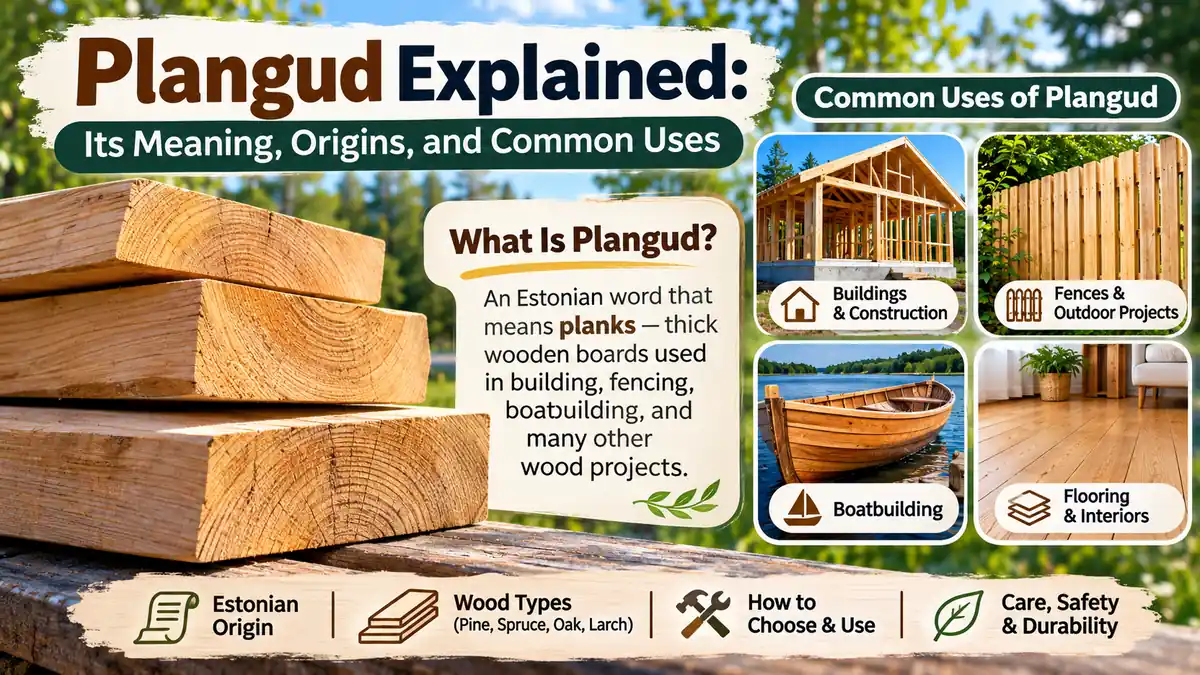
Plangud may look like the name of a modern service, but its clearest established meaning comes from the Estonian language. It is the plural form of plank, a word used for thick wooden boards. The term also appears in discussions of fences, building materials, and traditional woodwork.
Understanding it takes more than a direct translation. Different wood products serve different purposes, and Estonian grammar changes the form of a word depending on its place in a sentence. The spelling can also cause confusion when it appears on English-language websites.
This guide explains where the word comes from, how people use it, and what to know about the wooden materials it describes. It also separates established meanings from newer claims that are harder to verify.
What Does Plangud Mean?
In everyday Estonian, plangud means planks, or multiple thick wooden boards. Its singular form is plank. The term generally refers to solid pieces of sawn timber rather than thin sheets of plywood or other manufactured panels.
An Estonian dictionary describes a plank as a relatively thick board cut from a log, commonly about 5 to 10 centimeters thick. That description provides a useful picture, but timber sizes vary by country, seller, and intended use.
The same singular word can also describe a fence made from boards placed closely together. As a result, a sentence about plangud may involve pieces of wood, while another may involve solid wooden barriers. Context tells the reader which meaning fits.
Where Does the Word Come From?
The Estonian noun plank is a borrowed word. Its recorded history leads through Low German planke, referring to a thick board. Older related forms are found in Latin and, further back, Greek terms linked to timber or a tree trunk.
This history reflects how practical objects carry names across languages. People have traded wood, built fences, and made boats for centuries. Words for familiar materials often travel with those activities and take on local forms.
However, an older linguistic root does not mean that the modern Estonian plural was used in ancient Greece or Rome. Plangud is an Estonian word with its own grammar. Its earlier relatives help explain its history, not its current national identity.
How Plangud Works in Estonian Grammar
Estonian changes noun endings to show number and grammatical role. In the basic form, plank means one plank, while plangud means more than one. This is why a translation may show either spelling depending on the original sentence.
Other forms are useful too. Plangu can refer to one plank in the genitive case, and plankude is the plural genitive. You may also encounter planke, a form used in certain sentences involving multiple planks.
For example, the expression paksud plangud means “thick planks.” In plankudest aed, the ending indicates a fence made from planks. These examples show why translating each word separately can miss part of the meaning.
A separate Estonian word spelled plank can describe a printed form or blank document. It has a different history and grammatical pattern.
When reading Estonian, the surrounding sentence is more reliable than an isolated word on a screen. This distinction helps prevent a simple translation mistake.
How Wooden Planks Are Made
Most solid wood planks begin as logs harvested from suitable trees. A sawmill cuts each log into boards of different thicknesses and widths. The cutting pattern affects the visible grain, the amount of waste, and how the wood may move as it dries.
Freshly cut timber contains moisture. Drying reduces that moisture before many indoor uses, helping limit later changes in size. Kiln drying offers controlled conditions, while air drying depends more heavily on local weather and storage.
A finished piece is not automatically suitable for every job. Wood species, grade, moisture level, treatment, and thickness all matter. Builders should follow local standards when choosing timber that must support weight or resist weather.
Common Wood Types and Their Features
Pine and spruce are familiar softwoods in northern Europe. They are generally easier to cut and widely used for ordinary construction and interior projects. Their exact strength and outdoor performance depend on grade, treatment, and local conditions.
Oak is a hardwood valued for its density, visible grain, and use in long-lasting furniture and traditional craft. It is often heavier and more expensive than common softwoods. A good finish still matters, especially where water is present.
Larch is another wood sometimes selected for exterior work because of its natural characteristics. Yet no species is completely free from decay. Constant dampness, trapped water, and poor ventilation can shorten the life of almost any timber.
Plangud in Buildings and Flooring
Thick boards have long been useful in houses, sheds, workshops, and farm buildings. They can form floors, walls, platforms, and other parts of wooden structures. Modern construction may also use engineered products where stable dimensions or specific strength ratings are needed.
For flooring, the spacing and condition of supports matter as much as the boards themselves. A plank that works on a narrow span may bend or feel unstable over a wider one. Load requirements should come from the relevant building rules.
Wood expands and contracts as humidity changes. Proper drying, acclimation, and installation details help reduce gaps, cupping, and unwanted movement. Indoor floors also benefit from finishes chosen for wear resistance and ease of cleaning.
Fences and Other Outdoor Projects
Wooden planks are commonly used for privacy fences, gates, garden borders, and simple outdoor structures. Closely spaced boards can screen a yard from view. Wider spacing gives more airflow but reduces privacy.
Outdoor timber needs protection from repeated wetting and drying. Raised edges, drainage, suitable fasteners, and enough airflow can help. Boards placed directly against damp soil generally face greater decay risk than those kept clear of the ground.
A tall or exposed fence must also handle wind. Strong posts and correctly spaced supports are essential, and local rules may limit height or placement. Attractive planks cannot make up for a weak frame beneath them.
The Role of Planks in Traditional Boatbuilding
Wooden boats offer another clear example of planks in practical use. Boatbuilders shape timber to follow the curve of a hull. The boards must work together with ribs, joints, and fastenings to create a strong outer shell.
Two traditional methods are clinker and carvel construction. In clinker building, neighboring planks overlap. In carvel building, their edges meet to create a smoother hull surface. Both approaches require skilled fitting and suitable wood.
Boat planking differs from ordinary household carpentry. Traditional hulls may rely partly on controlled wood swelling and carefully maintained seams, while some modern methods use adhesives and sealed layers. Repairs must respect the original construction method.
How to Choose Suitable Planks
Start with the purpose of the project. Decorative shelving, a garden fence, a floor, and a boat repair place very different demands on wood. A clear plan helps you avoid paying for unsuitable material or using a weak board where strength matters.
Before buying, check three practical details:
- Size and grade: Confirm the actual dimensions and whether the timber is rated for the job.
- Moisture and condition: Look for serious warping, decay, splits, or damage.
- Exposure: Choose suitable durability or treatment for indoor, outdoor, or ground-contact use.
Look along the length of each piece to spot twists or bows. Small knots can be normal, but large defects may affect performance. When in doubt, ask the supplier what the grade permits and where the wood can safely be used.
Working With Planks Safely
Even simple wood projects create hazards. Rough edges can leave splinters, and heavy boards can fall or shift unexpectedly. Wear suitable gloves for handling, secure the material before cutting, and use eye and hearing protection around power tools.
Sawdust can irritate the lungs, including dust from untreated timber. Work with good ventilation and effective dust extraction. Use suitable respiratory protection when needed, especially while sanding or cutting treated material.
Pressure-treated wood requires extra care because it contains preservatives. Follow its product label and local guidance. Do not burn treated scraps, and never use treated wood for a cutting board or another surface intended for direct food preparation.
Structural projects need more than basic tool safety. Decks, stairs, raised platforms, and load-bearing frames must be designed for their actual loads. If a failure could injure someone, use approved specifications or qualified professional guidance.
Storage, Care, and Long-Term Durability
Store unused planks off the ground on level supports. Keep the stack stable and arrange supports to reduce sagging. If the wood is being dried, allow appropriate airflow rather than sealing damp boards under an airtight cover.
Outdoor finishes may help limit weathering, but their performance varies. A stain, paint, or protective coating should match the wood, its previous treatment, and the exposure it will face. Follow the maker’s preparation and application instructions.
Regular inspections are often more useful than waiting for damage to become obvious. Check exposed ends, joints, fasteners, and areas where water collects. Soft spots, loose fixings, and persistent moisture deserve attention before they spread.
Responsible Timber and Reducing Waste
Wood can be a renewable building material when forests are managed responsibly and products are used efficiently. Buyers can ask suppliers about the origin of their timber and whether credible forest-management or chain-of-custody certification applies.
Long-lasting design also reduces waste. Choosing suitable wood, keeping it dry where possible, and repairing minor damage can delay replacement. Reusing clean, sound offcuts for smaller projects is often more practical than throwing them away.
Reclaimed timber requires careful inspection. Old paint, hidden metal, decay, and unknown preservatives may make some pieces unsuitable for reuse. Never assume that wood from an old outdoor structure is safe for furniture or food-related purposes.
Why the Word Appears in Different Online Contexts
Some English-language pages describe Plangud as a productivity idea, planning method, or digital platform. These descriptions are different from its established Estonian meaning. An unfamiliar word can be attractive as a name, but that alone does not establish a recognized service.
Publicly verifiable details for a single, established planning product under this name remain unclear. Claims about official features, pricing, founders, or launch dates should therefore be treated carefully unless a specific provider can support them.
The spelling may encourage confusion because its opening letters resemble the English word “plan.” That resemblance does not make the Estonian word a translation of planning. Language history and modern branding are separate subjects.
Final Thoughts
Plangud is best understood first as an Estonian word meaning wooden planks. Its singular form, plank, also has a related fence meaning, while its history reaches back through older borrowed vocabulary. Those facts explain the term more clearly than unsupported claims about a new digital system.
In practical life, planks remain useful for floors, fences, furniture, boats, and many smaller projects. Their success depends on choosing the right species, size, grade, finish, and installation method for the job.
If you encounter the word on a website, consider the subject before accepting a definition. A description grounded in language or timber use is different from an unverified product claim. Clear context is the best guide.
Frequently Asked Questions (FAQs)
What does Plangud mean in English?
Plangud usually translates to “planks,” meaning multiple thick wooden boards. It is an Estonian plural noun, and the exact meaning depends on how it appears in a sentence.
Is Plangud an Estonian word?
Yes. It is the standard plural form of the Estonian noun plank when referring to thick boards. The singular word also has a related meaning involving a solid wooden fence.
Is Plangud a planning app or website?
Some online pages use that description, but a clearly established planning product with confirmed ownership and features has not been verified. Check the specific website before treating such claims as fact.
What are wooden planks commonly used for?
They are used in flooring, fences, furniture, boatbuilding, and other wood projects. The right type depends on the load, moisture exposure, required dimensions, and local construction rules.
How are planks different from ordinary boards?
A plank often suggests a thicker piece of sawn timber, although everyday English usage and trade sizes vary. In Estonian dictionaries, the timber meaning commonly describes boards around 5 to 10 centimeters thick.
How can wooden planks last longer outdoors?
Choose timber suitable for outdoor exposure, provide drainage and airflow, and maintain its protective finish when needed. Inspect joints and ends regularly, and replace any pieces with serious decay.




[…] International customers should not assume that nationwide Mexican coverage includes direct service to the United States, the United Kingdom, or other countries. Request confirmation of collection points, destinations, transfer arrangements, and the company responsible for each stage. […]
Comments are closed.