

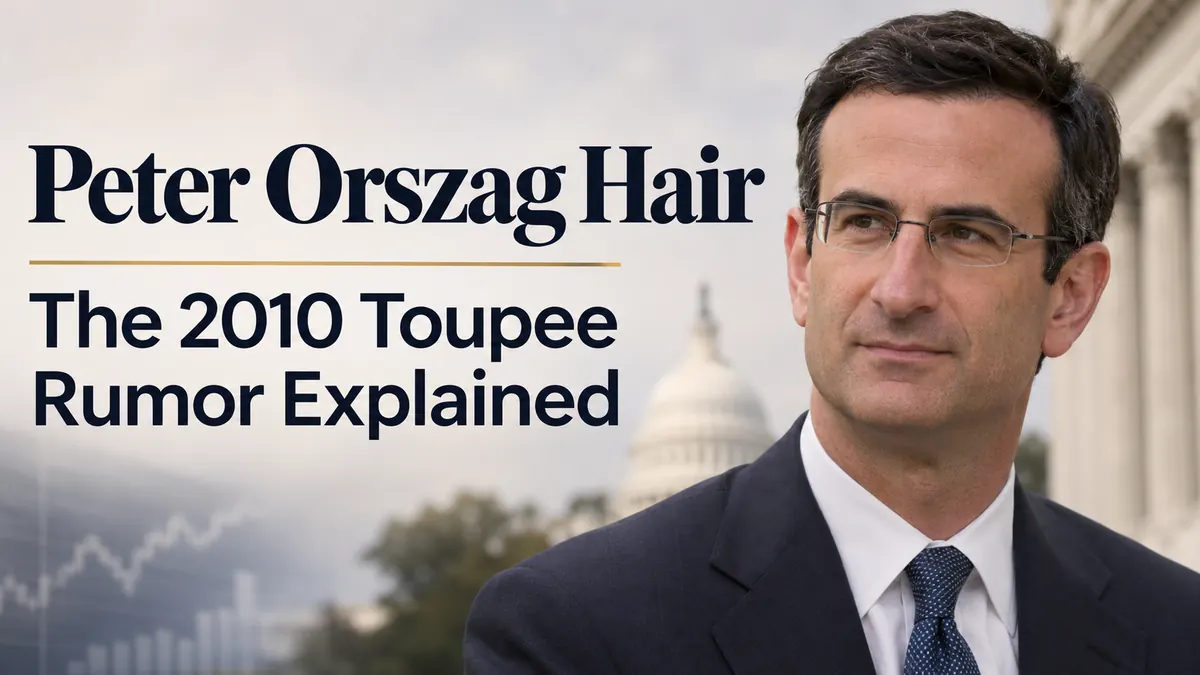
Peter Orszag’s hair became a subject of public speculation in 2010, when he was serving as director of the White House Office of Management and Budget. The discussion centered on whether his appearance in photographs suggested he wore a toupee. The claim attracted attention, but the available public reporting did not establish it as fact.
This article looks at how the rumor arose, what the coverage actually said, and what can responsibly be concluded today. It also explains why photographs alone cannot confirm whether someone wears a hairpiece or has had a hair treatment.
Why People Search for Peter Orszag’s Hair
Searches about Peter Orszag’s hair often ask whether he wore a toupee, what his hairstyle looked like, or why the subject appeared in news coverage. These questions trace back to a short period when his public profile grew and commentators discussed his appearance alongside his work in government.
The interest is unusual because Orszag is known mainly for economics, public policy, and finance. Yet public figures can become subjects of personal speculation when their faces appear often in news photographs and television interviews.
A useful account should separate three things: what was reported at the time, what can be seen in public images, and what remains unknown. Confusing those categories can turn an old joke or opinion into a claim that sounds confirmed.
Who Is Peter Orszag?
Peter R. Orszag is an economist and business executive. He served as director of the Congressional Budget Office before becoming director of the Office of Management and Budget during President Barack Obama’s administration. Those roles placed him in the national spotlight during debates about government spending and the economy.
After leaving government, Orszag moved into financial advisory work at Lazard. The firm’s public biography identifies him as its CEO and chairman and describes his career in finance, public policy, and academia. His professional record is well documented; his personal grooming choices are not a central part of it.
That background matters because the hair discussion arose during a time of high visibility. Orszag was a senior official whose public appearances drew attention. The prominence of the person helped the topic travel, but it does not make claims about his hair more reliable.
How the 2010 Toupee Rumor Began
The rumor circulated in early 2010, when online commentary and news coverage began discussing Orszag’s hair. Some writers compared photographs taken at different events and speculated about whether his hair was natural or a hairpiece.
One widely discussed article that month featured a hairpiece specialist reacting to photographs of Orszag. The specialist offered a personal opinion about what the pictures seemed to show. The article presented that comment in a lively, provocative style, which helped the story draw attention.
The key detail is that the specialist’s comments were based on photographs. The coverage did not describe a direct examination of Orszag or provide confirmation from him. That distinction is central to understanding why the story remains a rumor rather than a verified account.
What the Original Coverage Actually Said
The January 2010 coverage documented that people were talking about Orszag’s hair. It included a specialist’s judgment about images and used colorful language to describe the appearance that he thought he saw. The tone was closer to gossip and commentary than to a medical or investigative finding.
That article is evidence that the speculation existed. It is not proof that Orszag wore a toupee. A person’s opinion about a photograph, even when the person has relevant work experience, cannot establish what an individual uses unless the claim is independently verified.
Other commentary around the same time also treated the question as a matter of appearance and public interest. Repetition across outlets can make a claim seem more certain, but multiple discussions of one rumor do not necessarily provide multiple independent confirmations.
What the Reporting Does Not Prove
The 2010 reporting does not establish that Orszag wore a toupee, wig, or other hairpiece. It also does not confirm that he had a hair transplant, used a medical treatment, or experienced a particular kind of hair loss.
The public record described in that coverage does not include a direct statement from Orszag confirming the claim. Nor does it report an examination or other evidence that could settle the question. Without that kind of information, certainty would go beyond what the reporting supports.
A careful summary is straightforward:
- The rumor was discussed publicly in 2010.
- The discussion included opinions based on photographs.
- The available coverage does not independently verify the claim.
This distinction keeps the article informative without turning speculation into fact.
Why Photographs Can Lead to Hair Speculation
Photographs capture one moment under particular conditions. Lighting, shadows, camera angle, image quality, and a person’s position can all change how hair appears. A bright overhead light may make the scalp more visible, while a side angle can make the hairline look different from a front-facing portrait.
Styling can also affect appearance. Hair may be combed, parted, flattened, or lifted on different days. A close crop, an older image, or a low-resolution news photograph may hide detail that would be visible in person.
These factors do not prove that a photograph is misleading. They simply limit what it can establish. Images can show how someone looked in a specific moment, but they cannot reliably identify a hairpiece, a medical procedure, or a health condition on their own.
Toupee, Wig, and Hair Transplant: Different Claims
A toupee is a type of hairpiece designed to cover part of the scalp. A wig generally covers more of the head. A hair transplant is a medical procedure that moves hair follicles from one area of the scalp to another. These terms describe different things and should not be used as if they mean the same claim.
The 2010 discussion focused on the possibility of a hairpiece. That speculation should not be expanded into claims about surgery or treatment. A comment about how hair looks in a photograph offers no reliable basis for identifying a medical procedure.
For Peter Orszag, public information does not confirm any of these explanations. Unless he chooses to discuss the subject or trustworthy reporting provides direct evidence, claims about a toupee, transplant, or treatment should be described as unverified.
What Public Images Can and Cannot Tell Us
Public photographs can help explain why people noticed Orszag’s hair. They can show that his appearance drew attention during his time in government and that images prompted commentary. They can also provide a visual record of how he looked at particular public events.
Images cannot explain what caused a particular appearance. They do not reveal whether someone uses a hairpiece, has changed a hairstyle, or has undergone a procedure. Even a comparison of photographs from different years cannot answer those questions with certainty.
For that reason, image-based claims should use careful language. “A photograph led commentators to speculate” describes a documented reaction. “The photograph proves he wore a toupee” makes a claim the image cannot establish.
Orszag’s Public Image During His Government Career
As OMB director, Orszag was regularly photographed and interviewed. His work involved complex public issues, including federal budgets and economic policy. The intense news cycle around Washington helped make his face familiar to readers and viewers.
Public figures are often discussed in ways that extend beyond their work. Orszag’s hair became a small part of a larger conversation about his public image. That attention says more about media culture and the appetite for personal details than it does about his professional record.
The coverage should be understood in its period. It appeared in a media environment where political blogs, opinion pieces, and news outlets often mixed serious policy coverage with playful commentary about public figures. The tone of that discussion is not the same as evidence.
Why the Rumor Still Appears Online
Old stories can remain visible for years because people continue searching for names, images, and unusual details. A headline or a memorable phrase may be repeated by later websites, even when those pages add no new reporting.
When many pages repeat the same claim, readers may assume each page has confirmed it independently. Often, however, the pages point back to the same small set of original coverage. Repetition can increase visibility without increasing the amount of evidence.
This explains why a decade-old question may still appear current. It does not mean new proof has emerged. A recent page discussing an old rumor should be checked for fresh, reliable information rather than treated as confirmation because of its publication date.
How to Read Claims About a Public Figure’s Appearance
A useful way to assess a claim is to ask where it started and what evidence supports it. A direct interview, a clear statement, or credible reporting based on firsthand information carries more weight than a visual guess or a repeated online assertion.
It also helps to notice the language used. Words such as “appears,” “may,” or “speculated” signal uncertainty. If a later article removes those qualifications, it may present an old opinion as a settled fact.
For personal claims about someone’s health or appearance, restraint matters. A person’s public role does not make every private detail public knowledge. Readers can understand the history of a rumor without accepting it as true.
What Can Be Said About Peter Orszag’s Hair Today?
The safest factual statement is that Orszag’s hair became a subject of public discussion in 2010. The reporting from that period documented speculation based on photographs, but it did not provide conclusive proof that he wore a toupee.
His official professional biography focuses on his career and does not address his hair. That silence should not be treated as confirmation or denial. It simply means the public profile is not a source for answering the question.
There is also no need to infer a transplant, a medical condition, or a personal grooming routine from photographs. Without reliable confirmation, those details remain unknown. An accurate article can explain the rumor without pretending to solve a question for which the public evidence is limited.
Final Thoughts
The story behind Peter Orszag’s hair is a story about media attention and the limits of visual speculation. In 2010, commentators discussed whether photographs of the then-OMB director suggested he wore a toupee. That discussion made the rumor part of his public image, but it did not verify the claim.
The distinction between a rumor and a confirmed fact is important. A specialist’s opinion based on images may explain how speculation began, but it cannot stand in for direct evidence. Repeated articles do not change that unless they bring new, dependable information.
So, does Peter Orszag wear a toupee? The public coverage reviewed here does not establish that he does. The clearest answer is that a toupee rumor circulated in 2010, while the truth about his hair remains unconfirmed in reliable public information.
(FAQs)
Does Peter Orszag wear a toupee?
No reliable public information cited in the 2010 coverage confirms that he wears a toupee. The story involved speculation based on photographs, rather than a verified statement or examination.
When did the Peter Orszag hair rumor begin?
The discussion became prominent in early 2010, when Orszag was serving as director of the Office of Management and Budget. Media commentary focused on his appearance in photographs.
Did a hairpiece specialist examine Peter Orszag?
The widely discussed report described the specialist reacting to photographs. It did not establish that he examined Orszag in person, so his comments should be understood as an opinion about images.
Has Peter Orszag confirmed having a hair transplant?
The public information reviewed here does not confirm that he has had a hair transplant. The toupee speculation should not be expanded into a claim about surgery or medical treatment.
Can photos prove whether someone wears a hairpiece?
No. Photos can show how a person looked in a particular moment, but lighting, angle, styling, and image quality affect appearance. They cannot reliably confirm a hairpiece or medical procedure.
Why do people still search for Peter Orszag’s hair?
The topic remains searchable because articles and online commentary from 2010 continue to circulate. Repetition can keep an old rumor visible, even when it does not add new evidence.




[…] readers, the practical takeaway is simple: enjoy the videos, but treat personal information with care. A creator does not have to share a birthday or age. When reliable confirmation is missing, […]
Comments are closed.