

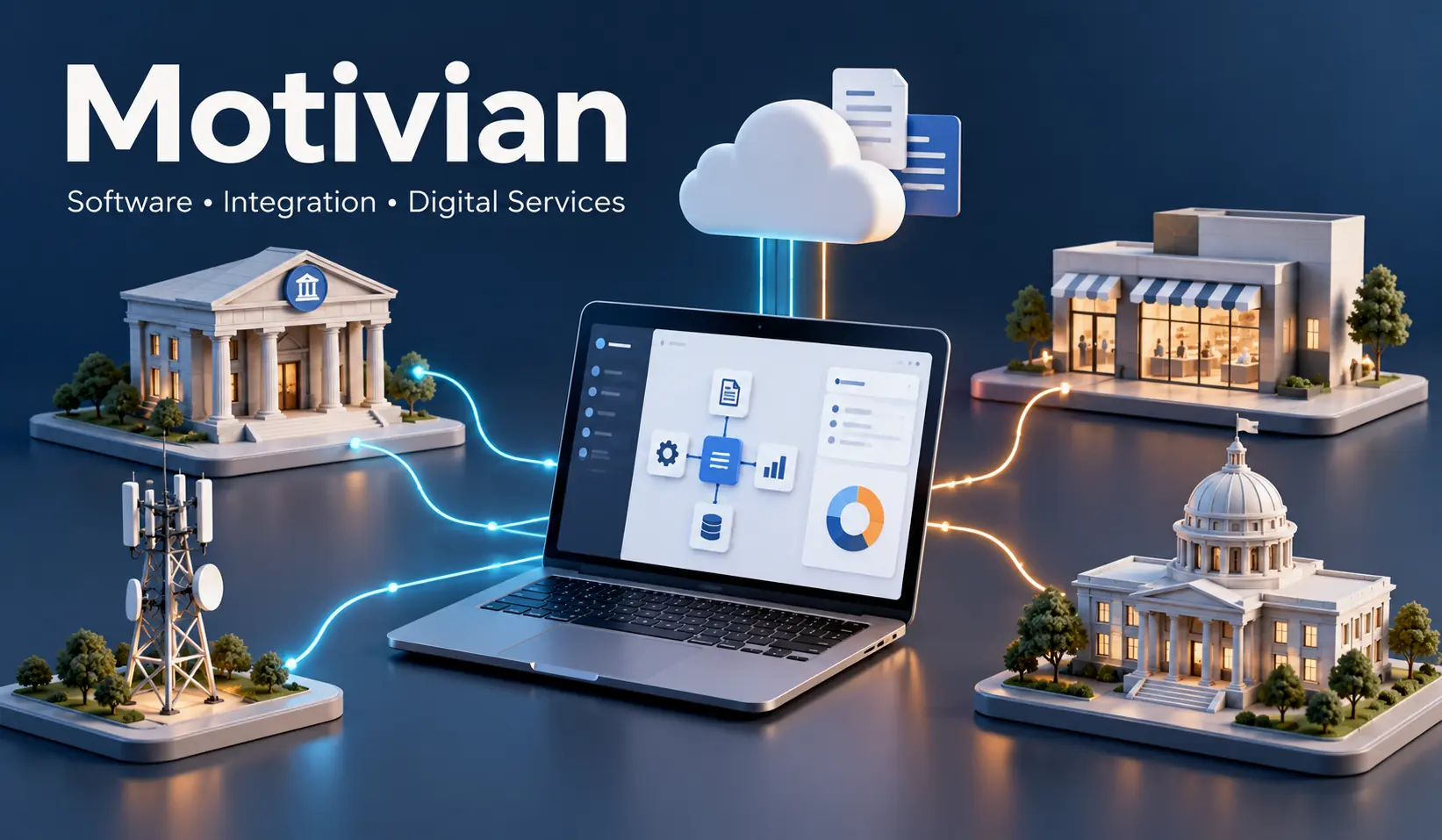
When a customer pays a bill online, applies for a loan, or checks an order, several systems may need to exchange information. The screen is only the visible part. Behind it are records, business rules, approval steps, and connections that keep the service working.
Motivian operates in this part of business technology. Its work spans enterprise software, digital services, and systems integration, with applications across banking, telecommunications, retail, and public administration.
For U.S. readers researching the company, understanding those functions is more useful than broad promises about digital transformation. This guide explains its background, service areas, published projects, and the practical questions that help establish whether its capabilities match a particular business need.
What Is Motivian?
Motivian is a software solutions and technology services company. It combines development work with integration and related services to help organizations manage operations and customer interactions. A project might involve a customer portal, an internal workflow, or connections between existing applications.
The term “software integrator” helps explain its role. An organization may already have separate tools for customer accounts, payments, and document storage. Integration creates a controlled way for those tools to exchange information and support a shared process.
This distinction matters when defining a project. A company seeking a better online experience may also need changes to the systems behind it. Evaluating both parts together gives the project a clearer scope and helps reveal dependencies before development begins.
Company Background and Geographic Presence
The business traces its incorporation to 2005, when it operated under the name VCI as an innovation incubator. Its published history identifies a management buyout in 2012, followed by a focus on commercial software solutions.
The company describes its regional activity as centered on Southeastern Europe and the Middle East. Its listed office locations include Athens, Greece; Sofia, Bulgaria; and Larnaca, Cyprus. Those locations provide context for its operating footprint and international project work.
For an American organization, geography raises practical delivery questions: which team would handle the engagement, when working hours overlap, and how support would operate. A regional company profile alone does not establish the delivery arrangements available for a specific U.S. project.
| Company detail | Overview |
|---|---|
| Original incorporation | 2005, under the name VCI |
| Management buyout | 2012 |
| Core business | Enterprise software and integration |
| Listed office cities | Athens, Sofia, and Larnaca |
| Stated regional focus | Southeastern Europe and the Middle East |
Web and Mobile Software Development
Motivian lists web development, mobile applications, interface design, and user experience among its capabilities. Its VIA Online content management system supports digital publishing, including previews and role-based access. These services address how people create and interact with digital information.
A useful development brief starts with a task. For example, a customer should be able to submit a service request, attach the right documents, and receive confirmation. That description gives designers and developers something more concrete to build than a general request for a modern website.
Performance should also be judged through real use. Can someone complete the task on a phone? Are instructions clear? What happens when information is missing? These questions help connect interface decisions to completion rates, support demand, and the quality of the finished service.
Systems Integration and IT Consulting
The company’s integration offering includes customer relationship management systems, enterprise resource planning software, and third-party applications. These are commonly shortened to CRM and ERP. Its consulting work also covers business and technology planning.
Consider an illustrative retailer whose online store and inventory application maintain separate stock records. A connection between them could reduce manual updates, but the project must establish which application controls the authoritative inventory figure.
Handling failures is equally important. If a connection stops working, transactions may need to wait, retry, or trigger a staff alert. A working demonstration should show how the proposed system handles these situations, alongside the normal customer journey.
Consulting is most useful when it turns those questions into agreed requirements. Before implementation, the customer should understand the proposed connections, responsibility for each data source, delivery milestones, and the evidence that will show the integration works correctly.
Business Process Automation and Document Management
Motivian’s published portfolio includes VIA Process for business automation and VIA docSTREAM for document management. Its Piraeus Bank case describes different approval procedures and role-based interfaces, illustrating how enterprise software can coordinate work across departments and submission channels.
In a typical workflow, an application moves from submission to review and then to a decision. Automation can route the application and record its status. Document management keeps supporting files connected to the case so employees can work from the same information.
The outcome depends on process design. Automating an unclear approval chain can preserve unnecessary steps. A stronger approach first identifies who makes each decision, what information they need, and where exceptions go. Evaluation can then track processing time, missing documents, and repeated manual work.
Digital Commerce and Customer Engagement
The company’s portfolio includes an e-commerce suite under VIA Online and a rewards platform under VIA Engage. It also presents marketing and campaign services. Together, these areas address the relationship between completing a transaction and encouraging customers to return.
A historical example is its Vodafone shopping case, which describes online ordering with delivery or store pickup. The practical challenge behind that experience is coordination: customers need accurate order information, while the business must connect online choices with fulfillment arrangements.
Rewards programs introduce a different question: does an incentive produce useful additional business? An illustrative evaluation could compare repeat purchases and gross profit between eligible customer groups. Counting enrollments or coupon redemptions alone cannot establish whether a campaign improved the business outcome.
Industries Served and Their Different Needs
Motivian identifies financial services, telecom operators, retail, fast-moving consumer goods, and government among its markets. Fast-moving consumer goods, often abbreviated FMCG, include frequently purchased products such as packaged food, beverages, and household supplies.
Although these industries share software needs, their processes differ. A bank may focus on tracking an application through approval. A telecom operator may focus on account services, while a public agency may need a clear route for citizens to submit and follow requests.
Research and development also appears in the company’s activities. Its published MECANEX project concerns multimedia annotation and adapting content across screens. Such participation demonstrates a research activity; any resulting capability still needs to be assessed against the requirements of a proposed commercial deployment.
| Sector | Relevant software application | Useful evaluation measure |
|---|---|---|
| Banking and finance | Application and approval workflows | Processing time and rework |
| Telecommunications | Account and online transaction services | Successful task completion |
| Retail and FMCG | Shopping and customer engagement | Order accuracy and repeat purchases |
| Public administration | Citizen portals and document workflows | Completion time and request status visibility |
What Published Projects Show
Specific projects make the service descriptions easier to understand. Motivian’s public portfolio includes a prepaid top-up service, banking workflows, document management, and government portals. The examples below are historical descriptions of project scope.
The One Stop Shop case, dated February 2015, describes digitizing 75 ministry processes and providing a central portal for labor and social security matters. That number indicates the stated scale of the project; it does not measure time saved or citizen satisfaction.
Historical cases help identify relevant experience, but prospective customers should also request a recent example with comparable requirements. The most useful discussion covers what was delivered, which systems were connected, and how results were measured after launch.
| Published project | Date shown | Described scope |
|---|---|---|
| Vodafone prepaid top-up | July 2013 | Online prepaid account recharging |
| Piraeus Bank loan origination | February 2015 | Loan application and approval workflows |
| Cyprus energy regulator document management | April 2015 | Document workflows, log monitoring, and backup |
| One Stop Shop | February 2015 | Digitization of 75 ministry processes |
What U.S. Businesses Should Clarify
For U.S. organizations, the first step is matching the proposed service to an actual operational problem. A useful brief identifies the affected users, current systems, transaction volume, and the task that needs improvement. This creates a basis for comparing proposals.
Commercial discussions should separate initial development from continuing costs. Ask which items cover software licensing, configuration, integration, hosting, training, and maintenance. A single headline price can be difficult to evaluate without knowing what the engagement includes.
Working arrangements deserve the same clarity. Establish the project’s communication schedule, expected availability during U.S. business hours, and the people responsible for resolving issues. Confirm what documentation and training the customer will receive.
Before signing off on delivery, agree on observable acceptance criteria. These might include completing a transaction, assigning the right user permissions, or recovering from a failed connection. Useful questions include:
- Which existing systems must exchange information?
- What can standard software handle, and what requires customization?
- How will users test the service before launch?
- Which measurable results will determine whether the project succeeded?
Support, Maintenance, and Long-Term Value
Motivian lists hosting, maintenance, quality assurance, and support among its services. These activities matter because business software continues to change after launch as users, connected applications, and operational requirements evolve.
Support terms should explain how incidents are reported and prioritized. A response target tells the customer when an issue will receive attention; a restoration target concerns getting the affected service working again. Understanding that distinction makes service discussions more precise.
Long-term value also depends on whether people can use and maintain the system. Clear documentation, staff training, and access to operational records should form part of the delivery discussion. A useful system needs both functioning software and an organization prepared to operate it.
Final Thoughts
Motivian’s profile brings together enterprise software development, integration, process automation, and digital customer services. Its published work offers concrete examples of those functions in banking, telecommunications, and public administration.
For a U.S. reader, the central question is how that experience fits a particular project. Relevant examples, a clear scope, measurable acceptance criteria, and workable support arrangements provide a stronger basis for evaluation than broad claims about innovation.
Start with the process that needs improvement and the result that would count as success. That approach makes it easier to assess a proposal, understand its costs, and judge whether the delivered software solves the original problem.
FAQs
What does Motivian do?
Motivian provides enterprise software solutions and technology services, including development, integration, and related support. Its projects can involve customer-facing services or internal business processes. The appropriate combination depends on the customer’s existing systems, users, and operational goals.
When was Motivian established?
The company traces its incorporation to 2005 under the name VCI. Its published history identifies a management buyout in 2012 and a subsequent focus on commercial software solutions. These dates describe different stages of the business’s development.
Where are Motivian’s offices located?
Its listed office cities are Athens in Greece, Sofia in Bulgaria, and Larnaca in Cyprus. U.S. organizations considering an engagement should confirm the delivery team, working-hour overlap, and support arrangements for their project rather than infer these from office locations.
Which industries does Motivian serve?
Its stated markets include banking and financial services, telecommunications, retail, fast-moving consumer goods, and government. These sectors use software for different tasks, from application processing to customer transactions. A relevant industry example should be examined for similarity to the proposed project.
Does Motivian offer custom software development?
Custom software development appears among its services. Buyers should clarify which requirements can be handled through existing functionality, which need configuration, and which require new development. That distinction helps explain delivery time, testing requirements, and the likely maintenance effort.
How much does a Motivian project cost?
This overview does not establish a verified project price or standard subscription fee. Request a written proposal tied to specific requirements, with development, integration, licensing, hosting, and ongoing services itemized. Compare the full scope and continuing costs when evaluating competing offers.