

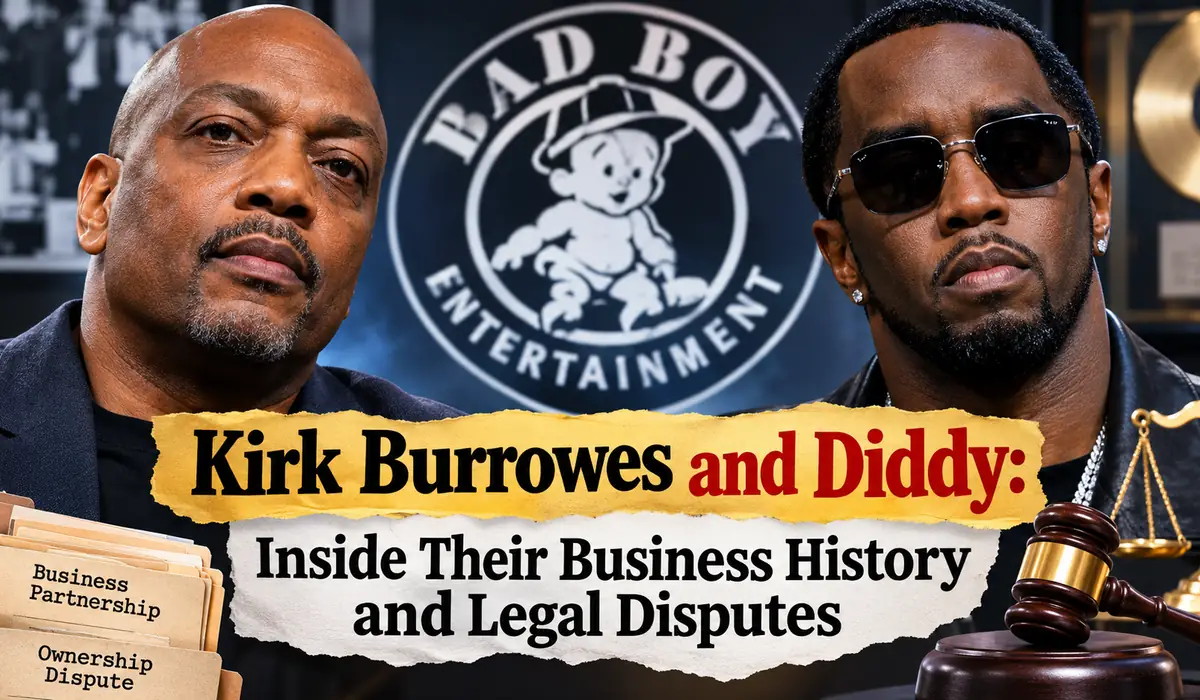
Kirk Burrowes helped build one of hip-hop’s best-known record companies, but his working relationship with Sean “Diddy” Combs ended in a dispute that has lasted for decades. What began as an ambitious music venture later became a fight over ownership, promises, and the way their partnership ended.
Burrowes says he lost a valuable share of Bad Boy Entertainment after being pressured to sign it away. Combs has denied the wrongdoing alleged in his former colleague’s lawsuits. Their competing accounts have appeared in court filings, interviews, and a recent documentary.
Understanding the story means separating the label’s documented rise from allegations that courts have not established as facts. It also means looking at why earlier cases were dismissed and what happened when Burrowes returned to court in 2025.
Who Is Kirk Burrowes?
Kirk Burrowes is an American music executive best known for helping establish Bad Boy Entertainment alongside Sean Combs in the early 1990s.
His responsibilities included business operations, budgets, and management. Accounts of the company’s early years identify him as a founding partner and general manager. He later held the title of president, placing him close to decisions that shaped the label’s future.
Burrowes became more widely discussed outside music circles because of his long-running dispute with Combs. That history involves a claimed ownership stake, allegations of intimidation, and several civil lawsuits.
How Bad Boy Entertainment Began
Bad Boy emerged in the early 1990s as Combs moved from his work at Uptown Records toward running a label of his own.
Burrowes joined the venture during its formative period. Business histories describe him as bringing management and marketing experience to the operation.
An arrangement with Arista Records helped give Bad Boy distribution and industry reach. The label soon became associated with artists including The Notorious B.I.G., Faith Evans, Total, and 112. The 1994 album Ready to Die became an early commercial breakthrough.
The rise was rapid, but the business was more than a collection of hit records. It involved artist contracts, recording costs, advertising, and relationships with larger music companies.
Burrowes’ Leadership and Daily Responsibilities
As general manager and later president, Burrowes occupied an important operational position. His work was less visible than an artist’s performance, yet a growing label depended on reliable oversight of spending, schedules, and staff.
He has said he handled company budgets and financial matters, sometimes including expenses connected with Combs’ personal activities. In later interviews, Burrowes described keeping detailed handwritten records of his work and decisions.
Those notebooks gained attention when he appeared in the 2025 documentary Sean Combs: The Reckoning.
The journals are part of his personal account. They may help explain what he recorded at the time, but their appearance in a film does not automatically prove every accusation associated with the broader dispute.
The Business Relationship With Sean Combs
The partnership brought together different strengths. Combs developed artists, directed promotion, and became a recognizable music figure. Burrowes helped manage the financial demands of that growth.
Their shared objective was to grow Bad Boy into a lasting entertainment company. As its artists gained fame and its deals became more valuable, questions about authority, profits, and ownership also carried greater weight.
The relationship later deteriorated. Burrowes describes a loss of trust and increasingly difficult treatment, while Combs’ representatives dispute his allegations.
The Disputed 25 Percent Ownership Stake
A central issue is Burrowes’ claim that he owned 25 percent of Bad Boy Entertainment. Earlier business accounts also describe a 25 percent interest assigned to him when the label was established. His lawsuits argue that the interest was taken from him without fair compensation.
Ownership is different from a job title or salary. A shareholder may have rights connected to the value, profits, and decisions of a company, depending on the governing agreements.
Burrowes has argued that he was promised an ownership share and a portion of profits for helping build the business. The precise legal rights, the effect of later documents, and who controlled the disputed interest have been contested rather than settled by the earlier court rulings.
That distinction matters. The existence of a claim does not establish that a transfer was unlawful.
What Burrowes Alleged Happened in 1996
Burrowes has repeatedly described an alleged confrontation in his office in May 1996. According to his court filings, Combs entered carrying a baseball bat while attorney Kenneth Meiselas presented paperwork affecting Burrowes’ interest in the company.
Burrowes claims the encounter placed him under pressure to sign away his stake. His early lawsuits characterized the event as coercive and tied it to the loss of the ownership rights he says he had earned. These remain allegations, not findings from a trial.
Descriptions of the encounter have appeared in legal proceedings and later interviews.
Combs has denied wrongdoing related to Burrowes’ claims. The older litigation did not produce a court finding that Combs threatened him with a bat or unlawfully seized the stake.
Why Their Working Relationship Ended
Burrowes remained connected to Bad Boy after the alleged 1996 incident and was named president in 1997. His departure followed during a difficult period for the label, which was also dealing with the March 1997 death of The Notorious B.I.G.
In the Netflix documentary, Burrowes claimed he was asked to replace pages in a signed agreement involving the rapper so that the terms would favor the company. He said he refused and was fired roughly three months later. That account is his allegation, not an independently established explanation for his dismissal.
The ending of the partnership became another part of his legal complaints. Burrowes accused Combs and others of interfering with career opportunities, including his relationship with singer Mary J. Blige. A New York appeals court later found that his particular interference claim was not adequately pleaded.
An executive’s exit can involve questions beyond an employment contract.
The 2003 Lawsuit Against Diddy
In June 2003, Burrowes filed a federal lawsuit against Combs, Bad Boy Entertainment, and attorney Kenneth Meiselas.
The federal complaint included claims under the Racketeer Influenced and Corrupt Organizations Act, commonly called RICO, as well as other legal theories. These included contract and business-related claims.
News coverage at the time described the dispute as involving about $25 million. That was a reported amount sought in litigation, not money a court determined he was owed.
A lawsuit, however, begins with one side’s version of events. Defendants may challenge its facts and its legal basis before a trial occurs.
Why the Earlier Cases Were Dismissed
In March 2004, a federal court dismissed Burrowes’ action. It ruled that his RICO claims were outside the four-year filing period and declined to continue considering the remaining state-law claims in that federal proceeding.
A federal appeals court affirmed the decision in 2005. The court did not accept his argument that the defendants’ conduct had prevented him from discovering the basis of his claims within the required period.
Burrowes also pursued a case in New York state court. In January 2006, an appellate court ordered the complaint dismissed. It concluded that most claims tied to the alleged 1996 incident were time-barred and that the separate claim concerning Mary J. Blige lacked sufficient allegations.
These rulings are often misunderstood. A limitations dismissal concerns when a legal claim can be brought. It is not the same as a trial finding that every allegation was false, nor is it proof that those allegations were true.
The New Complaints Filed in 2025
Burrowes returned to court in February 2025 with fresh civil actions. One complaint named Janice Smalls, also known as Janice Combs, the music executive’s mother. It alleged that she benefited from or concealed the disputed transfer of his claimed ownership interest.
Another complaint against Sean Combs raised allegations of sexual harassment, abuse, coercion, and professional retaliation connected with earlier years. That action later moved from state to federal court. Those are serious allegations and must not be treated as proven simply because they were filed in court. Combs’ legal team has rejected Burrowes’ claims.
The separate actions focused on different alleged conduct:
- The case involving Janice addressed claimed fraud and the disputed company interest.
- The case against Sean raised personal-misconduct allegations and related claims.
Burrowes argued that some of his more recent claims could be heard despite the passage of time. The defendants disputed their legal and factual bases.
What Happened in Court During 2026?
The new actions saw important procedural developments in 2026. In the case against Sean Combs, a federal judge ordered a pause on August 25 while appellate courts addressed a legal question involving deadlines for certain revived claims of gender-motivated violence.
That pause, called a stay, did not decide whether Burrowes’ allegations were true. It meant the judge would wait for guidance on a threshold legal issue before considering how the case should proceed.
In the separate case against Janice Smalls, a judge ruled on September 15 that an earlier motion to dismiss was moot because Burrowes had filed an amended complaint. A renewed request to dismiss that revised complaint was also before the court. The September decision was procedural, not a ruling that he had proved ownership or fraud.
As of the publicly available orders reviewed in November 2026, neither of those decisions established liability on the disputed allegations.
Public Responses and Documentary Attention
Combs’ lawyers have strongly disputed Burrowes’ recent allegations, describing his newest effort as an attempt to revisit matters already dismissed in earlier litigation. That is the defense’s position; the old dismissals do not by themselves settle the allegations newly presented in 2025.
Burrowes has continued to describe his experience through interviews and public appearances. He says the loss of his position and his dispute with Combs damaged his standing in entertainment.
The documentary Sean Combs: The Reckoning, released in December 2025, brought his account to another audience.
Documentaries can preserve testimony and reveal material that audiences have not seen before. They are not substitutes for a legal judgment, however.
Kirk Burrowes’ Life After Bad Boy
Burrowes has spoken about financial hardship and career setbacks following his exit from the company. In the documentary, he said that he had been shut out of entertainment opportunities for many years and experienced periods of homelessness.
Those statements describe his personal experience. The extent to which another person caused his professional difficulties remains disputed.
Burrowes has also discussed efforts to rebuild his career outside the record business. He has identified television and film development as areas of interest and spoken publicly about Pop Life Entertainment, a company associated with his more recent projects.
His story therefore does not end with the departure from Bad Boy or the old court decisions.
Final Thoughts
The history between Kirk Burrowes and Diddy shows how a successful creative partnership can become a long-running business and legal conflict.
The 2004 and 2006 dismissals are established legal outcomes. The alleged 1996 coercion, claims of later retaliation, and allegations in the newer complaints are contested matters that require careful wording. A court deadline ruling should never be confused with a full determination of what happened.
The renewed litigation and documentary attention have brought this history back into public discussion.
Frequently Asked Questions (FAQs)
Who is Kirk Burrowes?
Kirk Burrowes is a music executive and early Bad Boy Entertainment leader who worked with Sean Combs during the label’s rise in the 1990s. He later became known for lawsuits concerning his claimed ownership rights and treatment at the company.
Did Kirk Burrowes co-found Bad Boy Entertainment?
Yes. Accounts of the company’s early history describe him as a founding partner alongside Sean Combs. He served in major management roles, including general manager and president.
Why did Kirk Burrowes sue Diddy?
He alleged that he was pressured to give up a 25 percent ownership interest and suffered other harm tied to their relationship. Later complaints raised additional allegations, which Combs disputes.
Did a court prove that Diddy threatened Kirk Burrowes?
No. The earlier court cases were dismissed mainly because of filing deadlines and other legal deficiencies. Those outcomes did not establish that the alleged confrontation happened.
What happened to the 2025 lawsuits?
In 2026, the action against Sean Combs was stayed while a related legal issue was considered. A separate case against Janice Smalls also faced dismissal motions. The orders discussed here did not decide the underlying ownership claims.
Where is Kirk Burrowes now?
Burrowes has discussed work in television and film through Pop Life Entertainment. He also appeared in the 2025 documentary Sean Combs: The Reckoning and has continued publicly discussing his Bad Boy history.