

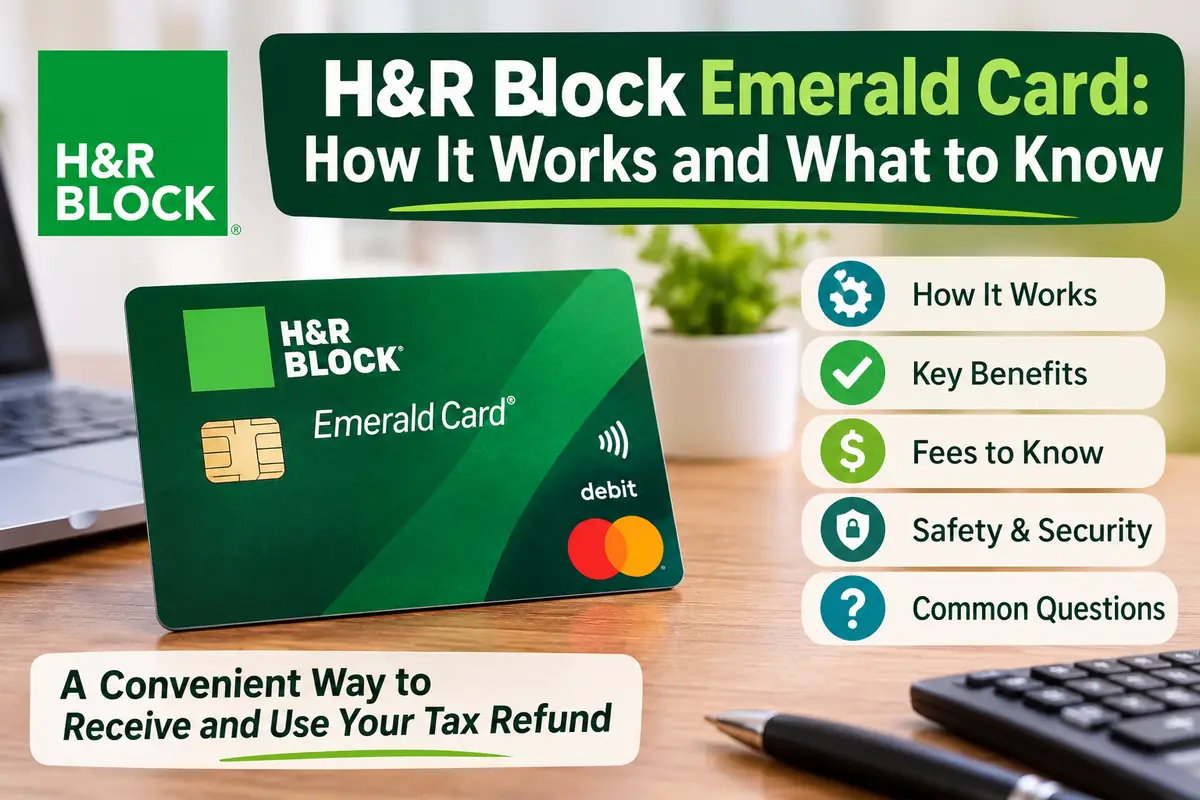
The H&R Block Emerald Card gives people a way to receive a U.S. tax refund and use the money without waiting for a paper check. Yet it is not the same as a standard bank checking account, and some services carry fees.
Understanding those differences matters before you choose where your refund goes. The card may be convenient if you do not have a bank account or prefer a separate place for refund money. Frequent withdrawals, however, can make it costly over time.
This guide explains how the card works, how to get one, where to use it, how to check your balance, and what charges to watch for.
What Is the H&R Block Emerald Card?
The H&R Block Emerald Card is a reloadable prepaid Mastercard linked to a card account. H&R Block offers it through its U.S. tax services, while Pathward, N.A., an FDIC-insured bank, issues the card.
Unlike a credit card, it does not provide a credit line. You generally spend funds already available rather than borrow money and repay them later.
The card is designed for receiving tax refunds, but it is not limited to tax season. Eligible cardholders can also receive payroll or certain government payments and add funds through supported methods during the year.
Although it supports many daily payments, the card account is not a checking or savings account. It does not pay interest.
How Does the Emerald Card Work?
Think of the card as a spending tool connected to a prepaid balance. Purchases, cash withdrawals, and eligible transfers reduce that balance, while new deposits increase it.
At checkout, you use the card where Debit Mastercard is accepted, subject to merchant acceptance and account restrictions. The payment is taken from available funds.
You do not need to open a separate traditional bank account just to hold funds on the card. Even so, you should keep enough money available for planned bills, because merchant holds and service fees can affect your spending balance.
Who Can Get an Emerald Card?
The card is mainly a U.S. financial product offered through H&R Block’s tax preparation service. You can request one at a participating tax office or during an eligible virtual tax appointment.
Applicants must meet identification requirements. The cardholder agreement generally requires applicants to be at least 18, or 19 in Alabama and Nebraska. The issuer can request your address, date of birth, and other identifying details.
Readers in the UK and other countries should not assume local availability simply because H&R Block operates internationally. The Emerald Card is tied to the U.S. program.
How to Get and Activate Your Card
You can ask about the Emerald Card while filing with a participating H&R Block tax professional. In-office customers may receive a new physical card on the same day.
Before relying on the card, complete the activation instructions provided with it. You may need to confirm personal details and set or verify a personal identification number, known as a PIN. Never activate a card through a link sent by an unknown person.
For a smooth setup, keep three items ready:
- Your physical card and its activation instructions.
- The personal information used for your application.
- A secure phone or device for account access.
After activation, check that you can sign in and view your card details. This makes it easier to receive account notices or replace the card if needed.
Receiving a Tax Refund on the Card
One of the card’s main uses is receiving a federal or state tax refund through an eligible deposit arrangement. When you prepare your return, choose the Emerald Card refund option if it is offered and confirm the account details before filing.
A refund is not available just because your tax return has been submitted or accepted. The IRS or state tax agency must process and release the payment.
H&R Block also offers an optional Refund Transfer service that can let eligible customers pay tax preparation charges from their refund. This is separate from the card itself and has its own fee. The published charge is $42, and choosing the Emerald Card does not automatically mean you need Refund Transfer.
Refund transfers are not loans and do not make the government approve a refund faster. Likewise, a separate refund advance or Emerald Advance loan, when available, involves approval and its own terms.
Adding Money After Tax Season
The card is reloadable, which means it can be used after you receive your refund. Eligible customers can arrange direct deposits of wages, unemployment payments, or certain government benefits.
Another option is depositing an eligible check through the MyBlock app’s Check-to-Card service. Checks are reviewed before approval. A slower funding choice may have no service fee, while faster access can involve a percentage-based charge.
You may also be able to add cash at participating retail reload locations. Retailers can charge their own convenience fees, and deposit limits apply.
Some cardholders can transfer funds from a linked bank account. This feature is not available to everyone and may have transaction limits or bank-side charges.
Using the Card for Shopping and Cash
You can use your card for everyday purchases wherever Debit Mastercard is accepted. The card normally has no fee for each purchase, although the merchant may impose its own charges in certain situations.
Cash access is available through compatible ATMs, but withdrawals can become expensive. The card issuer charges an ATM withdrawal fee, and the ATM operator may add another charge. Some stores offer cash back with a purchase, which may reduce card withdrawal costs.
Hotels, car rentals, and pay-at-the-pump fuel purchases may place temporary holds on funds. These holds can make your available balance appear lower than expected, even before the final charge posts.
Checking Your Balance and Transactions
The easiest way to monitor your money is through Emerald Online or the MyBlock mobile app. Signing in lets you review recent payments and deposits without visiting an ATM.
You can also call Emerald Card customer service at 1-866-353-1266 to get balance information.
An ATM can sometimes show your balance, but this method may cost money. The card’s fee schedule lists a $1 ATM balance inquiry charge, and the machine owner may charge an additional fee.
Cardholders can view about 12 months of account history online and request at least 24 months of written transaction history without a fee.
Emerald Card Fees You Should Know
The card is advertised without an annual fee, and ordinary purchase transactions carry no card fee. However, that does not mean every action is free.
Under the September 2026 agreement, the card fee for an ATM withdrawal is $3.75, plus any ATM operator charge. An over-the-counter cash withdrawal at a financial institution carries a 2% fee. Retail cash reload fees can reach $4.95, depending on the provider.
The inactivity fee deserves attention. If you complete no transaction for 60 days, the agreement lists a $9.95 fee each month until qualifying activity resumes or the account is otherwise handled.
Standard replacement card delivery is listed as free, while expedited delivery costs $15. Fees and terms can change, so review the agreement for your own account before making a costly transaction.
Daily Limits and Account Restrictions
Like other prepaid products, the Emerald Card has limits intended to manage risk and account activity. Cash reloads, ATM withdrawals, and purchases may each have separate restrictions.
The September 2026 agreement lists a $1,000 daily cash reload limit, a $9,500 monthly cash reload limit, and up to $3,000 in daily ATM withdrawals. Security checks may also reduce limits for particular transactions.
These numbers are not a promise that every cardholder can withdraw the full amount immediately. Your available balance, merchant policies, ATM rules, and account status all matter.
How Safe Is the Emerald Card?
Funds held through the card’s issuing bank may qualify for pass-through FDIC deposit insurance, subject to legal requirements and coverage limits. This insurance generally concerns failure of an insured bank, not losses from scams, merchant disputes, or someone being careless with account details.
The card also has Mastercard Zero Liability protection for eligible unauthorized purchases when its conditions are met.
Call 1-866-353-1266 promptly if you believe the card has been lost or used without permission. Under the card agreement, reporting theft within two business days can limit liability for certain unauthorized transactions. Waiting may increase potential losses, depending on the circumstances.
Protect the account with a strong password and private PIN. Avoid messages that ask you to reveal a one-time code, make a payment to release your refund, or share your full card number.
Benefits and Drawbacks to Consider
A major benefit is convenience. If you do not have a checking account, a prepaid card can let you receive eligible deposits and pay for goods without cashing a paper refund check.
The ability to add deposits throughout the year adds flexibility. The MyBlock app provides account management, while access to the Mastercard network makes the card useful for many everyday purchases.
The main trade-off is cost when you use certain services. Frequent ATM withdrawals, retail reloads, or long periods without activity can consume part of your balance.
For someone who wants regular bill payments, broad bank transfers, or a dedicated savings account, a conventional checking account or another banking product may be a better fit.
Common Problems and How to Get Help
If your card is declined, start by checking your available balance and account status. An incorrect PIN, temporary merchant hold, or transaction limit may explain a rejected purchase.
If a refund has not arrived, check its status with the relevant tax agency before assuming the card is at fault. An accepted return and an issued refund are different stages.
If you lose your card, report it immediately rather than waiting to see whether it turns up. Ask customer service how to stop unauthorized use and request a replacement.
For login problems, use the normal account recovery process instead of creating multiple accounts or sharing private details with someone offering help online. Support can also explain how to review an unfamiliar charge.
Final Thoughts
The H&R Block Emerald Card can be a practical way to receive a U.S. tax refund and spend the funds without opening a traditional checking account.
The best experience comes from understanding the charges before using it. Normal purchases may be free, but ATM withdrawals, inactivity, and certain funding methods can reduce your balance.
Choose the card if its convenience matches your habits, and make a plan for any money left after tax season. Compare the total cost with an ordinary checking account before deciding.
Frequently Asked Questions (FAQs)
Is the H&R Block Emerald Card a credit card?
No. It is a reloadable prepaid debit card, so your spending generally comes from money deposited into your card account. It does not provide a normal revolving credit line or build credit through everyday card purchases.
Can I use my Emerald Card without a bank account?
Yes. You can receive eligible deposits and make purchases without opening a separate checking account. However, not every banking feature is available, and some cash access or funding methods have fees.
How do I check my Emerald Card balance for free?
Use Emerald Online, the MyBlock app, or the card’s customer service phone line. These methods do not carry a card balance-check fee, although your mobile provider may charge for data or messages.
Can I receive my paycheck on an Emerald Card?
Eligible cardholders can receive payroll direct deposits if their employer supports the arrangement. Check the account details and setup instructions provided through your card account before sending them to payroll.
What happens if my Emerald Card expires?
A card’s expiration does not automatically mean its remaining money disappears. The issuer may provide a replacement card or return funds by check, subject to the agreement. Contact support and keep your mailing address current.
Does the Emerald Card charge a monthly fee?
There is no standard annual card fee, but an inactivity charge may apply after 60 days without a completed transaction. The published agreement lists $9.95 each month under those conditions, so monitor any unused balance.