
Modern businesses depend on technology to serve customers, manage information, and keep daily work moving. Yet it can be hard to separate useful advances from bold promises. Artificial intelligence, cloud systems, and automation are changing quickly, and many business owners want clear explanations before making costly decisions.
Droven.io Enterprise Tech Innovation is a term readers may encounter while looking for information about these changes. It connects the technology topics covered by Droven.io with the wider question of how organizations improve their systems, processes, and services.
There is an important distinction. Droven.io presents itself as a technology publication, not as a single enterprise application that companies install. Its articles discuss products, ideas, and industry trends rather than providing one verified software suite under that name.
This 2026 overview explains what the website covers, how enterprise innovation works, and what readers should check before acting on technology advice.
What Is Droven.io Enterprise Tech Innovation?
Droven.io Enterprise Tech Innovation describes the connection between Droven.io’s business technology coverage and the tools that organizations use to modernize their work. The phrase is best understood as an informational topic, not an official product name with a fixed set of features.
Droven.io publishes articles about artificial intelligence, software, digital transformation, cybersecurity, and related subjects. Its homepage presents an editorial hub with guides, technology news, practical tips, and reviews. Readers can explore these topics without needing to operate a special platform.
Enterprise technology innovation means improving the way an organization works through new or better digital systems. A retailer might use stock forecasting to reduce shortages. A hospital might improve appointment scheduling. A logistics company might connect delivery records with customer updates.
These examples show the shared idea: technology matters when it solves a real problem. Reading about an approach is the starting point; planning, testing, and responsible use determine whether it helps a business.
What Topics Does Droven.io Cover?
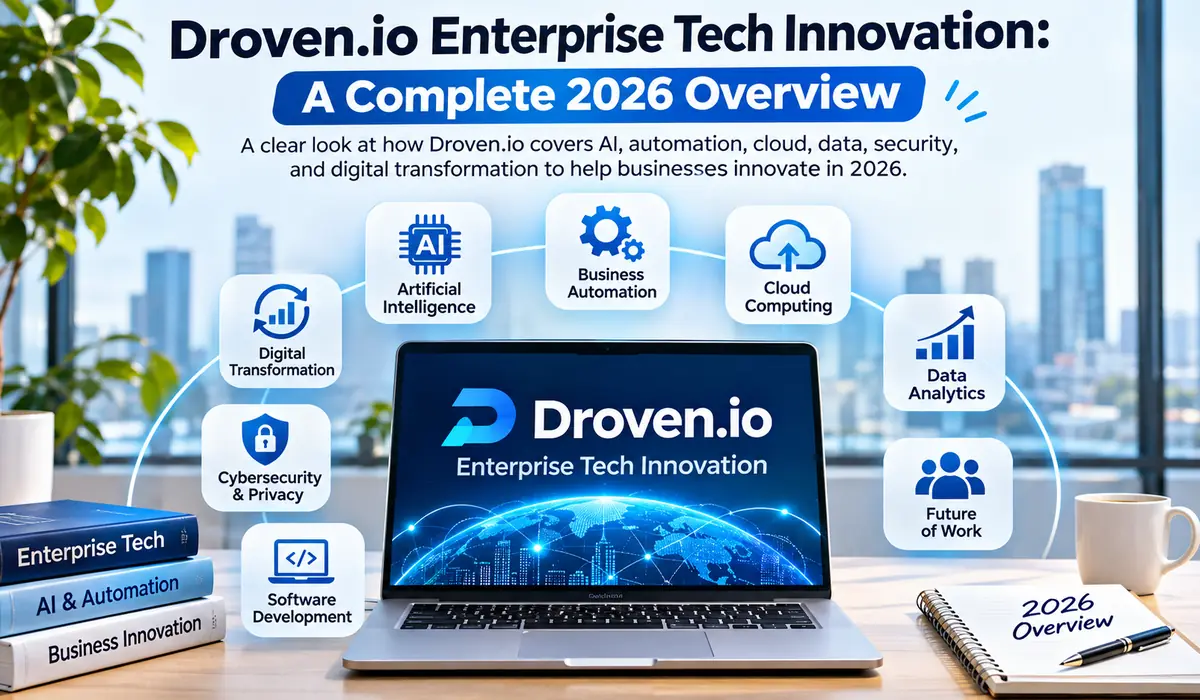
The website organizes material into areas such as artificial intelligence, information technology, digital transformation, and technology reviews. Within those areas, visitors can find articles about generative AI, business processes, cloud computing, software development, and digital privacy.
This broad range is useful for readers who are still exploring their options. Someone interested in better customer service can begin with AI assistants, then learn about workflow automation and the need to protect customer records.
However, an article category is not proof that Droven.io builds or sells the products discussed. The site’s visible purpose is to publish information. Readers should treat product selection and purchasing as separate decisions.
Why Enterprise Technology Innovation Matters in 2026
Companies face pressure to work faster while keeping costs and risks under control. Customers expect reliable online services, quick answers, and consistent experiences. Employees need systems that reduce repeated tasks rather than create extra work.
Modern technology can help by connecting departments that once worked with separate records. For example, when sales, inventory, and support teams use accurate shared data, they can respond to an order without sending several emails to confirm its status.
Innovation does not always require a dramatic overhaul. Replacing an error-prone spreadsheet, improving backups, or simplifying staff access to approved files may deliver more value than buying a costly new AI system. The right change depends on the business problem.
Artificial Intelligence and Generative AI in Business
Artificial intelligence helps software recognize patterns, classify information, or make predictions. Businesses may use it to estimate demand, flag unusual transactions, or route customer requests to the right team. Results depend heavily on the quality of the data and the system design.
Generative AI is a related field that can produce text, images, code, and other material. Staff may use it to draft routine messages, summarize long documents, or explore early ideas. Droven.io covers tools and applications in this growing area.
These tools still need people to review their work. Generated text can contain false statements, and automated recommendations may overlook important context. A company should not send private records to an unapproved tool or allow an assistant to make sensitive decisions without safeguards.
Business Automation and Smarter Workflows
Automation lets software carry out repeatable steps with less manual effort. It can move data between approved systems, send reminders, create routine reports, or alert staff when a task needs attention. This is different from expecting a computer to make every decision.
For example, an online store might automatically send an order confirmation, update its inventory record, and notify a warehouse team. Employees can then focus on unusual cases, customer questions, and problems that need judgment.
Robotic process automation often works with existing applications by following defined steps. More advanced workflows may combine rules, software connections, and AI. Both approaches require checks to prevent wrong or outdated information from spreading.
Cloud Computing and Modern IT Systems
Cloud computing allows organizations to use computing resources and applications delivered through remote services. Teams can access approved tools from different locations, while providers handle parts of the underlying infrastructure.
Businesses use cloud services for shared documents, backups, databases, websites, and computing workloads. A growing company may add capacity without purchasing and maintaining every server itself. Yet cloud services are not automatically cheaper or more secure.
Costs can rise when storage, data transfer, and unused resources are poorly managed. Companies also need to understand where information is stored, who can access it, and how they would recover operations during an outage.
Big Data, Analytics, and Better Decisions
Business analytics turns collected information into useful findings. A company might study sales trends, delivery times, website activity, or equipment failures to understand where improvement is possible. Dashboards can make these patterns easier to see.
Big data refers to information that may be too large, fast-moving, or varied for simple methods. Not every business needs a large data platform. A small firm can still gain value from accurate records and a clear monthly report.
Poor data can create confident but misleading conclusions. Before relying on a forecast or AI model, businesses should check how records were gathered, whether important details are missing, and whether results hold up over time.
Cybersecurity and Data Privacy
As businesses connect more systems, they also create more places where information could be exposed. Cybersecurity includes protecting devices, accounts, networks, and records against theft, disruption, and unauthorized access. It is a basic part of innovation, not an optional extra.
Simple controls can prevent many avoidable problems. These include multifactor authentication, regular updates, limited account permissions, staff training, and tested backups. No single control removes every threat, so organizations need several layers of protection.
Privacy requires equal care. Before collecting customer or employee information, a company should ask why it needs the data, how long it must keep it, and who can view it. Requirements vary by country and industry.
Software Development and Connected Tools
Software development turns business needs into applications and services. It can involve building a customer portal, updating an old internal system, or connecting separate products so they share information accurately.
Application programming interfaces, often called APIs, allow approved programs to exchange data. For instance, a booking system may connect with billing software so teams do not have to enter the same details twice. Connections should have clear permissions and reliable error handling.
Modern development also involves testing, monitoring, and regular updates. Shipping a feature quickly is not enough if it breaks an existing process or exposes customer information. Good teams plan how to fix problems after launch.
Digital Transformation Across Industries
Digital transformation is a broader change in how an organization serves people and operates. It may include new software, but it also involves training, business rules, customer experience, and leadership decisions. Installing an application alone does not complete the work.
In retail, connected stock records can help staff check availability across locations. In manufacturing, equipment data can support planned maintenance. In healthcare, carefully managed digital records may reduce repeated paperwork and improve coordination.
Service businesses can also benefit. An accounting firm may organize client documents through secure portals, while a travel company may make booking updates easier to track. Each example requires attention to access, reliability, and staff needs.
The Future of Work and Employee Skills
Technology changes the tasks people perform, but the effects differ across jobs. Software may handle routine reports while employees spend more time solving complex problems, supporting customers, or reviewing exceptions. Some roles will need new skills and clearer responsibilities.
Training works best when it matches real work. A short lesson on checking an AI-generated summary can be more useful than a long presentation filled with technical terms. Employees need time to practice and a safe way to report mistakes.
Managers should explain what a new system will do, what it will not do, and how performance will be measured. They should also listen to workers who understand the gaps in current processes. Those details often determine whether a rollout succeeds.
How to Use Droven.io for Business Research
Droven.io can serve as an introduction when readers want to understand an unfamiliar technology. Start with a topic that matches a current need, such as reducing paperwork, choosing cloud software, or learning how AI supports customer service.
As you read, separate explanations from product claims. A general guide can help you learn the terms, while a review may introduce features worth comparing. Neither should replace a live demonstration or your own requirements.
For a focused review, keep three questions in mind:
- What specific problem would this technology solve?
- What would it cost to buy, secure, and maintain?
- How could we test the results before wider use?
Once the questions are clear, consult product documentation, ask vendors about limitations, and involve the people who will use the system. This turns general reading into a more disciplined business decision.
What to Check Before Trusting Technology Claims
Technology articles can be helpful without being perfect. Check when a post was published or updated, whether claims are supported by clear examples, and whether it distinguishes proven functions from predictions. Features and prices can change after an article appears.
Be careful when another website describes Droven.io as a ready-made enterprise software suite. Its public pages primarily show editorial sections and published articles. Do not assume that it provides a proprietary AI dashboard, consulting package, or subscription service without finding direct evidence.
Look closely at promises of guaranteed savings, flawless automation, or instant business growth. Real outcomes depend on staff, data, implementation costs, and ongoing support. A balanced explanation should discuss risks and limits alongside possible benefits.
Final Thoughts
Droven.io Enterprise Tech Innovation is most useful as a way to explore how modern business technology is changing. Droven.io offers articles about AI, automation, cloud systems, data, security, and digital transformation rather than a clearly established all-in-one enterprise product.
The lessons behind these subjects are practical. Start with a genuine business need, protect information, involve employees, and measure results. A modest improvement that works reliably can be more valuable than a complex project with uncertain benefits.
As technology continues to develop beyond 2026, thoughtful research will remain important. Readers who understand both the opportunities and the limits of new tools are better prepared to make choices that last.
Frequently Asked Questions (FAQs)
What is Droven.io Enterprise Tech Innovation?
It is a term used for the business technology topics associated with Droven.io, including AI, automation, and digital transformation. It does not appear to be a clearly defined enterprise software product.
Is Droven.io an AI software company?
Droven.io’s public website presents articles, guides, and reviews about AI and technology. Readers should not assume it sells its own AI platform without verifying a specific product offering.
What technology subjects can readers find on Droven.io?
The site covers generative AI, business automation, cloud computing, cybersecurity, software, data analytics, and the future of work. Its articles range from broad explainers to discussions of particular tools.
Can small businesses benefit from enterprise technology ideas?
Yes. Small firms can use affordable tools to improve scheduling, reporting, customer service, and information security. The key is choosing a manageable problem and testing whether a solution delivers value.
Is enterprise technology innovation only about artificial intelligence?
No. AI is one area, but reliable networks, cloud services, well-designed software, secure data, and employee training also matter. Improvements often require several of these elements to work together.
How should a company evaluate a new technology tool?
Define the problem, compare total costs, review privacy and security terms, and test the tool with real tasks. Ask employees for feedback and confirm that the results justify wider use.