

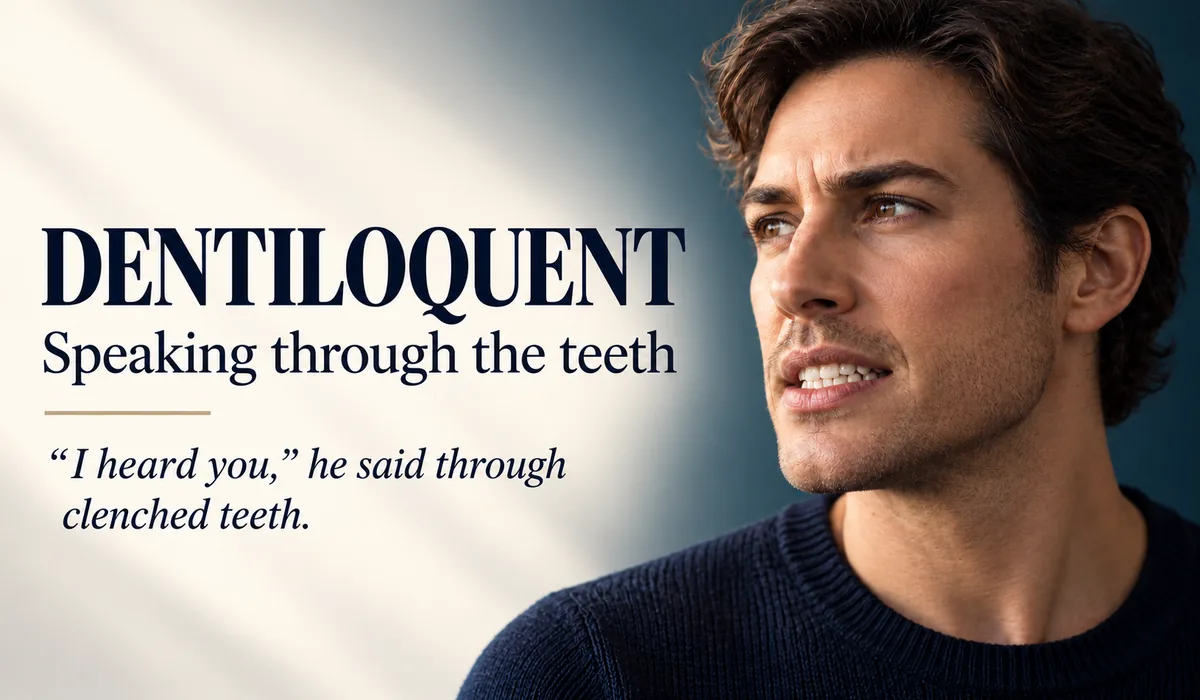
Some words name an action, while others describe the way that action happens. Dentiloquent belongs to the second group. It describes speech made through or between the teeth, often with the jaw held tight and the mouth barely open. The word is rare, but the image it creates is easy to understand.
You might meet it in a story, a vocabulary list, or a discussion of unusual English words. It can make a scene feel tense, secretive, or dramatic, but the word itself does not prove what a speaker feels. The surrounding words and events give readers that information.
This guide explains what dentiloquent means and shows how it can work in sentences, dialogue, and descriptive writing. It also covers the difference between speaking through the teeth and related actions such as mumbling, whispering, and muttering.
What Does Dentiloquent Mean?
Dentiloquent is an adjective for speech produced through or between the teeth. A dentiloquent speaker may keep the teeth close together while talking, which can make the voice sound tight, strained, or less clear than usual.
The word describes the manner of speaking. It does not automatically mean the person is angry, afraid, lying, or trying to threaten someone. Those meanings may come from the scene, but they are not built into the word itself.
For a simple everyday explanation, use “speaking through clenched teeth” or “talking through one’s teeth.” These phrases are more familiar to most readers and often make the meaning clear without further explanation.
How Speech Through the Teeth Looks and Sounds
When someone speaks through their teeth, their jaw may stay nearly closed. The lips can move only a little, and the teeth may remain pressed together or close enough to limit how widely the mouth opens.
The sound depends on the speaker and the words. It may come out low, clipped, muffled, or sharp. Some sounds remain clear, while others can be harder to understand because the mouth is not moving freely.
In writing, you can show the physical detail without explaining every motion. A small cue such as “her jaw stayed tight” or “he spoke without opening his mouth” can help readers picture the delivery.
Dentiloquent Examples in Sentences
Examples are useful because this is an uncommon word. In each sentence, dentiloquent describes how a line is spoken, rather than what the words mean.
- The coach gave a dentiloquent reply, his jaw still set after the close game.
- “I heard you,” Maya said in a dentiloquent voice.
- He delivered the warning in a low, dentiloquent tone.
- Her dentiloquent answer was difficult to hear over the crowd.
The first sentence gives a possible emotional context, but the word alone does not tell us why the coach’s jaw is set. The next examples show the word with different nouns: “voice,” “tone,” and “answer.”
Dentiloquent Dialogue Examples
Dialogue can make the speaking style easier to imagine. Use a brief action or voice cue near the spoken words so readers know how the line sounds.
“Leave the file on my desk,” he said through clenched teeth. The short line and tight delivery suggest strain, though the reason for it depends on the scene.
In another scene, a character might say, “I’m fine,” in a dentiloquent voice while trying to keep a smile. The contrast between the words and the delivery can signal that the character is holding something back.
A narrator could also write, “She answered dentiloquently, her lips barely parting.” This is more formal and less familiar than “she answered through clenched teeth,” so it may suit literary narration better than casual dialogue.
Using the Word to Build a Scene
A dentiloquent line can add a physical detail to a scene. It may help readers picture a character speaking while keeping the jaw still, the teeth close, or the mouth only slightly open.
The word can work well when a writer wants a precise, unusual description. It is especially useful when the scene has already established the character’s expression or posture, allowing the reader to understand the delivery without a long explanation.
Because many readers will not know the term, consider pairing it with a plain cue the first time it appears. For example: “He gave a dentiloquent answer, speaking through tightly set teeth.” The brief explanation lets the story continue smoothly.
Does Dentiloquent Mean Someone Is Angry?
Not by itself. People often picture anger when they hear about speaking through clenched teeth, because anger can cause a person to tense the jaw. But the same physical manner of speaking might occur during fear, pain, cold, restraint, or a deliberate performance.
Context helps readers work out the emotion. A character who grips a chair and answers through tight teeth may seem angry or stressed. A person speaking that way after a dental procedure might be uncomfortable. The situation shapes the interpretation.
If the emotion matters, name it or show it through action. A sentence such as “She spoke through her teeth, forcing herself to stay calm” gives the reader more information than dentiloquent alone.
Dentiloquent, Mumbling, Whispering, and Muttering
These terms all describe ways people speak, but they point to different features. Dentiloquent focuses on speech made through the teeth. Mumbling focuses on unclear speech, often because the speaker does not form words clearly or speak loudly enough.
Whispering is very quiet speech made without the usual voice sound. Muttering is low, often hard-to-hear speech that may be spoken to oneself or under the breath. A person could speak through clenched teeth and also mutter, but the two words do not mean the same thing.
Choose the term that describes the detail you want readers to notice. If the mouth position matters, “through clenched teeth” is clear. If the low volume matters, “muttered” may fit better.
Dentiloquent and Related Word Forms
The noun dentiloquy refers to the act or practice of speaking through the teeth. It names the manner of speech, while dentiloquent describes a person, voice, answer, or other thing associated with that manner.
A dentiloquist is a person who speaks through the teeth. This word is also rare, so it may need a plain-language explanation in general writing. In many cases, “a person who spoke through clenched teeth” is easier for readers to grasp.
These related terms appear in older and specialist dictionary records, but they are not common in everyday conversation. If your goal is clarity for a broad audience, use the familiar phrase unless the rare form adds something important.
How to Use Dentiloquent Naturally
Since the word is unusual, one clear use is often enough. Repeating it in each paragraph can make writing feel forced and may distract readers from the scene.
It commonly modifies a noun connected to speech, such as “voice,” “reply,” “remark,” or “answer.” For example: “His dentiloquent remark ended the argument.” The sentence is grammatically sound, but some readers may pause over the adjective.
You can improve clarity by providing a nearby cue. “He made a dentiloquent remark, his teeth barely parting as he spoke” introduces the word and shows its meaning at the same time.
Common Mistakes to Avoid
One mistake is treating dentiloquent as a synonym for angry. A tight jaw may suggest anger in a particular scene, but the word describes the physical delivery. If a character’s feeling is central, include another clue.
Another mistake is using it to mean any unclear speech. A person who mumbles may not be holding their teeth together. A dentiloquent speaker may be quite audible, even if the words sound tense or clipped.
It is also easy to overuse the rare word to make prose sound more formal. If a familiar phrase communicates the image faster, use it. A rare word is most effective when it is accurate and the sentence gives readers enough context.
A Short Practice in Description
Consider the line, “He said, ‘Not now.’” The words alone tell us little about the speaker’s voice. Adding a delivery detail can change the scene: “He said, ‘Not now,’ through clenched teeth.”
You could make the same sentence more literary by writing, “His dentiloquent ‘Not now’ came out in a clipped whisper.” This combines the adjective with a volume cue, though the reader may need the surrounding context to understand why he speaks that way.
Try revising a line of dialogue by deciding which part matters most: mouth position, volume, clarity, or emotion. Then select a word or phrase that describes that specific feature instead of relying on a string of similar adjectives.
Final Thoughts
Dentiloquent describes speech made through or between the teeth. It can offer a compact way to describe a voice, answer, or line of dialogue, especially in literary writing where a precise image matters.
The word does not state an emotion on its own. Anger, fear, restraint, or discomfort must come from the scene or from additional details. Keeping that distinction clear helps the description stay accurate.
For everyday writing, “speaking through clenched teeth” is usually the clearest choice. Use dentiloquent when its rare, concise form suits the voice of the piece, and give readers enough context to follow it.
(FAQs)
What does dentiloquent mean?
Dentiloquent describes someone speaking through or between the teeth. It focuses on the physical way speech is produced, rather than the speaker’s emotion or message.
Is dentiloquent a common English word?
No. It is a rare word and is not widely used in everyday speech. Most people say “talking through one’s teeth” or “speaking through clenched teeth” instead.
Can dentiloquent mean angry?
Not on its own. A person may speak through the teeth while angry, but the word describes the manner of speaking. The scene must provide clues about the person’s feelings.
How do you use dentiloquent in a sentence?
Use it to describe a voice, reply, or other spoken remark. For example: “She gave a dentiloquent answer, her jaw held tight.”
What is the difference between dentiloquent and mumbling?
Dentiloquent refers to speaking through the teeth. Mumbling refers to speaking unclearly or indistinctly, and it does not require the speaker to keep their teeth together.
What is the noun form of dentiloquent?
Dentiloquy is a noun for the act or practice of speaking through the teeth. Dentiloquist refers to a person who speaks that way.




[…] as an app or digital tool. I could not confirm reliable official documentation that establishes one widely recognized product with that name and a consistent set of features. Claims about logins, paid plans, downloads, or account tools […]
Comments are closed.