

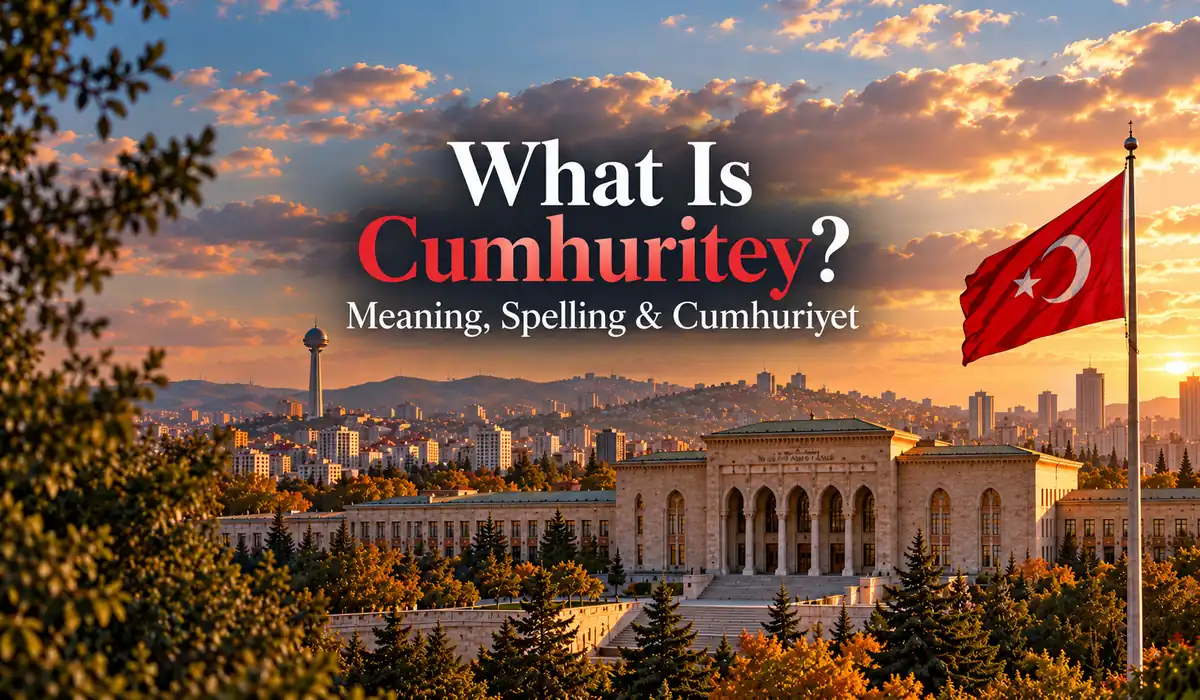
“Cumhuritey” is an uncommon spelling that appears online. It does not have a clearly established meaning of its own in the references consulted. The closest well-documented Turkish word is Cumhuriyet, which means “republic.” The two spellings are similar, but they should not be treated as interchangeable without explanation.
This guide explains what can be said with confidence about the term, how it relates to Cumhuriyet, and why readers may see the two spellings used together. It also covers the Turkish Republic’s history, Republic Day, and the difference between a republic and a democracy.
What Does Cumhuritey Mean?
There is no widely accepted definition for “Cumhuritey.” Online pages often connect it to Cumhuriyet, but that connection does not establish “Cumhuritey” as a separate Turkish word or political idea.
The most careful interpretation is that it may be an informal spelling variant, a typo, or a word someone has encountered without context. Its precise origin and intended meaning are not clear from the available evidence.
If a page uses “Cumhuritey” to describe civic values or a political movement, check whether it explains that meaning with reliable evidence. Without such evidence, it is safer to treat the term as an uncertain spelling and explain the better-documented word it may refer to.
Is Cumhuritey a Real Turkish Word?
“Real word” can mean different things. A spelling may appear in online posts or articles without being a standard entry in a major dictionary. Online use alone does not show that a term has a settled meaning in Turkish.
The established word Cumhuriyet is listed in Turkish language references. The Turkish Language Association’s dictionary gives it a political definition tied to national sovereignty and elected representatives. Cambridge translates “republic” as cumhuriyet.
That evidence supports Cumhuriyet as the recognized form. It does not establish “Cumhuritey” as a standard word. If you are writing about the Turkish form of government, the correct spelling is Cumhuriyet.
Cumhuritey vs. Cumhuriyet: What Is the Difference?
The main difference is spelling and evidence. Cumhuriyet is a documented Turkish word meaning “republic.” “Cumhuritey” is an uncommon form whose intended meaning seems to depend on the writer or context.
The two forms may look close to readers who do not know Turkish. That similarity can lead to confusion, especially when a page uses the unfamiliar spelling in a headline but discusses Turkey’s history or republican government in its text.
Use Cumhuriyet when you mean the Turkish word. Use “Cumhuritey” only when discussing that exact spelling, such as when explaining a search query or correcting a text. This keeps the article clear and avoids suggesting both words have equal standing.
What Does Cumhuriyet Mean in English?
Cumhuriyet means “republic.” In a republic, public authority is not held as the personal property of a monarch. The government operates through public institutions, and citizens have a role in choosing or authorizing political leaders.
The Turkish Language Association defines cumhuriyet in terms of sovereignty held by the nation and exercised through representatives elected for set periods. Cambridge’s English–Turkish dictionary also gives cumhuriyet as the Turkish translation of “republic.”
The word can also appear in proper names. For example, it is part of Cumhuriyet Bayramı, the Turkish name for Republic Day, and Cumhuriyet, the name of a Turkish newspaper. Context helps show whether the word refers to a form of government, a holiday, or a publication.
Where Does the Word Cumhuriyet Come From?
The Turkish Language Association’s dictionary traces cumhuriyet to Arabic cumhūriyyet. The entry also gives its political meaning in Turkish. This is useful background for understanding the established word, but it does not prove a separate origin for “Cumhuritey.”
In English, “republic” refers to a system of government in which political authority belongs to the public or nation rather than a hereditary monarch. The details vary by country: republics may have different constitutions, elections, legislatures, and executive leaders.
The history of Cumhuriyet is tied closely to the modern Turkish state. The word became especially significant when Turkey’s parliament declared the state a republic in 1923. The modern political history belongs to Cumhuriyet, not to the unverified spelling “Cumhuritey.”
How Was the Republic of Turkey Founded?
The Republic of Turkey emerged after the First World War and the Turkish War of Independence. The Grand National Assembly in Ankara became central to the new state’s political life. The assembly adopted a constitution in 1921, before the formal proclamation of the republic.
On October 29, 1923, the assembly declared that Turkey’s form of government would be republican. Mustafa Kemal Atatürk became its first president, and İsmet İnönü became its first prime minister. These events are documented in the Turkish parliament’s history and the Ministry of Culture and Tourism’s timeline.
The proclamation followed major changes to the old political order, including the abolition of the sultanate in 1922. The republic’s early years brought further constitutional and political changes. A careful account should explain this sequence instead of implying that one date captures every part of the country’s transformation.
Why Is October 29 Important in Turkey?
October 29 marks the proclamation of the Republic of Turkey in 1923. The Grand National Assembly approved the republican form of government, and Mustafa Kemal was elected president. The date is now observed as Republic Day, or Cumhuriyet Bayramı in Turkish.
The date matters because it represents a formal change in how the state was organized. It also became a lasting national symbol connected with sovereignty and the founding of the republic.
It is useful to distinguish the date of the proclamation from the longer history behind it. The republic followed years of conflict, political debate, and state-building. October 29 is the key anniversary, while the events that led to it span a wider period.
What Is Cumhuriyet Bayramı?
Cumhuriyet Bayramı means Republic Day. It is observed in Turkey on October 29 to mark the proclamation of the republic. The date is listed among Turkey’s national days by the Ministry of Foreign Affairs.
The holiday connects the word Cumhuriyet to public memory and national history. It is not a separate meaning for “Cumhuritey.” When writing about the holiday, keep the Turkish name and its English translation distinct and spell each one carefully.
Readers may search for “Cumhuritey” while looking for information about the holiday or the Turkish republic. A helpful explanation can gently point them to Cumhuriyet Bayramı and clarify that the familiar spelling is the one used in the established name.
Is a Republic the Same as a Democracy?
A republic and a democracy are related ideas, but they are not identical. “Republic” describes a form of state in which public authority is not held by a hereditary monarch. “Democracy” concerns how people take part in political decisions and how leaders are chosen or held accountable.
Many countries are both republics and democracies, but the terms do not mean the same thing. The word “republic” by itself does not explain how free or fair elections are, how much power citizens have, or how well rights are protected.
This distinction helps explain why the meaning of Cumhuriyet should not be stretched to include every political value. It means “republic.” Ideas such as participation, equality, or civic duty may be discussed in connection with a country’s political life, but they need their own clear explanation.
Is Cumhuriyet Also the Name of a Newspaper?
Yes. Cumhuriyet is also the name of a Turkish newspaper. The Atatürk Encyclopedia states that the paper began publication in Istanbul on May 7, 1924, and identifies Yunus Nadi Abalıoğlu as its founder and editor through 1945.
This matters because a search for Cumhuriyet may lead to results about the newspaper rather than the Turkish word for “republic.” The surrounding context usually makes the meaning clear: articles about news coverage refer to the publication, while language or political history pages refer to the word or system.
“Cumhuritey” should not be used as the newspaper’s name. The established spelling is Cumhuriyet. If an article discusses both the newspaper and the political term, it should identify which one it means when first introducing each topic.
Why Does “Cumhuritey” Appear Online?
The exact path by which “Cumhuritey” appeared online is not clear. It may come from a typing error, an attempt to spell a word heard aloud, or confusion with the established spelling Cumhuriyet. These are possible explanations, not verified accounts of its origin.
Search results can make an unfamiliar form look more established than it is. When several pages repeat a similar explanation, that repetition does not prove the explanation is accurate or that language authorities recognize the form.
A responsible article should state what is known and mark what is uncertain. In this case, Cumhuriyet has a clear dictionary meaning and historical use; “Cumhuritey” does not have the same level of documentation in the sources consulted.
How Should You Use the Term Accurately?
If you are writing about the Turkish word for “republic,” use Cumhuriyet. If you are writing about Turkey’s national holiday, use Cumhuriyet Bayramı and explain that it means Republic Day. If your subject is the newspaper, identify it as the publication Cumhuriyet.
When the focus is the unusual spelling itself, keep the claim narrow. You can say that “Cumhuritey” is a form people may encounter online and that it appears to be linked to Cumhuriyet. Avoid assigning it a formal definition or an independent cultural history without strong evidence.
For a quick check, keep these points in mind:
- Cumhuriyet is the established Turkish word for “republic.”
- “Cumhuritey” is an uncertain spelling with no clear independent definition in the sources consulted.
- Turkey’s Republic Day is Cumhuriyet Bayramı, observed on October 29.
Final Thoughts on Cumhuritey
“Cumhuritey” may attract attention because it resembles a meaningful Turkish word, but its own meaning is not firmly established. The clearest documented link is to Cumhuriyet, which means “republic” and has a central place in Turkey’s political history.
The distinction is simple: write Cumhuriyet when referring to the Turkish word, the republic, Republic Day, or the newspaper. Treat “Cumhuritey” as an uncertain spelling unless a specific source provides evidence for another use.
That approach gives readers useful context without overstating what is known. It also helps separate a real word and its history from an online form whose origin and intended meaning remain unclear.
(FAQs)
What does Cumhuritey mean?
“Cumhuritey” has no widely accepted definition in the sources consulted. It appears to be an uncommon spelling linked to Cumhuriyet, the Turkish word for “republic.”
Is Cumhuritey a correct Turkish spelling?
The established Turkish spelling is Cumhuriyet. “Cumhuritey” is not supported as the standard spelling in the dictionary and language references consulted.
What does Cumhuriyet mean in English?
Cumhuriyet means “republic.” It can also appear in names, including Cumhuriyet Bayramı for Republic Day and Cumhuriyet for the Turkish newspaper.
When was the Republic of Turkey proclaimed?
The Grand National Assembly proclaimed Turkey a republic on October 29, 1923. Mustafa Kemal Atatürk was elected its first president that day.
Is Cumhuritey another name for Republic Day?
No established source supports “Cumhuritey” as the name of the holiday. Republic Day is called Cumhuriyet Bayramı in Turkish and is observed on October 29.
Is a republic always a democracy?
No. A republic describes a state without a hereditary monarch, while democracy describes how people participate in political power. A country can be a republic without meeting every standard of a democracy.