

People often discover unfamiliar websites while looking for clear answers about technology, money, health, or everyday life. SparkPressFusion com is one name that appears in discussions about online articles and digital publishing. Its broad subject range can be useful, but the name also creates some confusion.
The website at sparkpressfusion.com presents itself as a general-interest digital publication. It focuses on readable articles across several categories rather than offering a confirmed software product or writing application.
This guide explains what readers can expect, how its sections are organized, which features matter, and how to judge the information carefully. It also explains why similarly named websites should not be mistaken for the same service.
What Is SparkPressFusion com?
SparkPressFusion com is the name people commonly use when referring to sparkpressfusion.com, a website that publishes informational articles. Its content spans technical subjects, personal interests, and practical topics that affect daily decisions.
The publication describes itself as an independent, multi-topic source of knowledge. Instead of concentrating on one industry, it organizes material into separate categories so visitors can move between subjects without changing websites.
For example, a reader interested in artificial intelligence may also find articles about household technology, financial terms, or legal rights. The variety supports casual browsing.
The Website’s Purpose and Intended Audience
The main purpose of the site is to introduce topics in language that general readers can follow. Its subject mix suggests an audience looking for background information rather than specialized training or professional advice.
Students may use introductory articles to understand unfamiliar terms before exploring textbooks or formal learning materials. Working professionals may read about developments outside their own fields, such as changes in digital tools or business practices.
Broad publications help with quick overviews, but easy explanations are only starting points. Readers should look for more detailed evidence when a decision involves money, health, safety, or legal rights.
Exploring the Main Article Categories
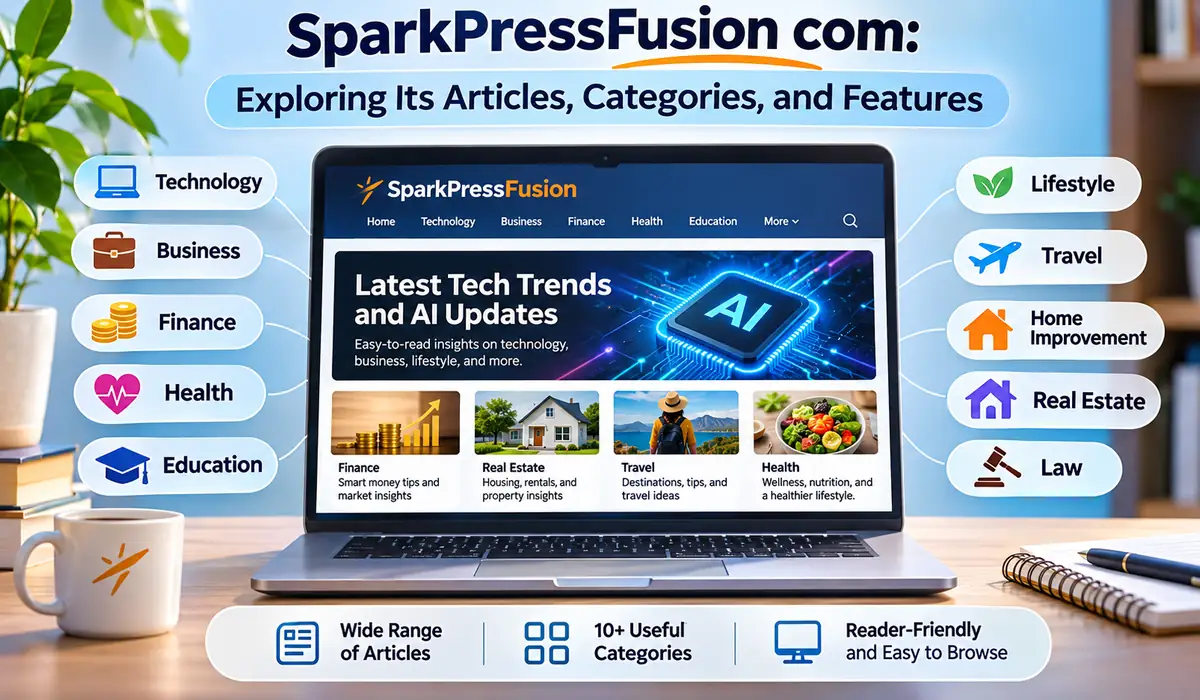
SparkPressFusion com has been described as organizing its articles into ten main categories. These categories cover both current developments and topics that remain useful over time. They make browsing easier for people who already know their area of interest.
The categories can be grouped into three broad areas:
- Work and learning: Technology, Finance, Business, and Education.
- Personal interests: Health, Lifestyle, and Travel.
- Property and rights: Home Improvement, Real Estate, and Law.
This structure helps explain why the site can look like an online magazine instead of a specialist journal. Articles from different fields appear under one publication, but each category addresses a different kind of reader question.
Category labels help with navigation, not with proving expert review. Someone exploring medical or legal material should evaluate each article separately, even if a technology article on the same site seems accurate.
Technology and Artificial Intelligence Articles
Technology is one of the site’s most visible subject areas. Reported articles cover artificial intelligence, Android features, software changes, deepfakes, and digital systems.
Such subjects may appeal to readers trying to follow developments that can change how they work, communicate, or use everyday devices.
An article about phone permissions, for instance, can introduce why apps request access to certain information. Coverage of deepfakes can help a beginner understand why convincing synthetic images and videos raise concerns about trust.
The technology category may also discuss enterprise systems and how organizations adopt new tools. For exact specifications or release details, check original announcements.
Reading about artificial intelligence is different from being offered an artificial intelligence tool. The presence of technology content on the publication does not establish that the site provides an AI assistant, automation dashboard, or software subscription.
Business and Finance Topics
Business articles have been described as covering operations, inventory, company growth, and planning. These topics can help beginners learn the language used in small businesses and larger organizations without assuming prior experience.
Finance coverage includes personal money concepts, investing terminology, lending, and market subjects. These articles may help a reader understand the meaning of a financial product or a common term before asking more detailed questions.
However, financial information can become outdated or depend heavily on local rules. Readers in the United States, United Kingdom, and elsewhere should verify current rates, regulations, and product terms through appropriate official or professional channels.
Health, Education, and Lifestyle Content
The health category has been associated with general wellness, nutrition, and developments in diagnostics. These subjects can make complex ideas easier to approach, especially when an article explains what a scientific term means.
Education topics reportedly include learning technology, AI tutors, training, and assessment. Such coverage may be useful to students, parents, teachers, and people considering new ways to develop practical skills.
Lifestyle articles offer a different kind of reading experience, touching on personal development, relationships, careers, and books. They provide room for broader interests beyond the site’s business and technology material.
The most important distinction is between information and individual advice. An article discussing a health condition cannot diagnose a reader, and an education trend does not prove a certain method will suit every learner. Context matters.
Travel, Home Improvement, Real Estate, and Law
Travel coverage reportedly looks at tourism developments, destinations, and changing ways of working while away from home. Readers may use these pieces to discover ideas, then confirm current entry rules, transport schedules, and local conditions elsewhere.
Home improvement articles focus on practical living spaces, including smart-home technology, decoration, and property upgrades. They may help readers compare ideas before deciding what fits their home, climate, and budget.
Real estate content addresses housing, rentals, and changes in property technology. It can introduce common terms, although property costs, tenant protections, and buying procedures differ widely between countries and even regions.
Law articles are particularly sensitive because rules depend on jurisdiction and circumstances. General explainers about consumer rights or legal procedures should not replace the wording of local laws or guidance from a qualified professional.
Website Layout and Reader-Friendly Features
The site’s reported design follows a magazine-style layout, with topic navigation and article previews. This familiar structure allows readers to choose a category, open a headline, and continue to related material without learning a complicated interface.
Its public-facing pages have also included an About section, contact information, and policy pages. Such pages explain what a publication says about its purpose and how visitors may get in touch with its operators.
For ordinary reading, an account or software installation has not been shown as necessary. This differs from account-based reading services.
These are website features, not guarantees of content quality. A clear layout and working navigation improve usability, but readers still need to consider dates, author details, and the evidence behind any important claim.
How to Browse and Use Articles Effectively
Start with the category closest to your question. Someone researching a smartphone update should begin in Technology, while a reader looking into housing terms may find the Real Estate section more relevant.
Pay attention to when the article was published. A general explanation of inventory control may stay useful for years, while a report about phone software, visa conditions, or interest rates can age quickly.
Finally, compare important statements with information that comes directly from the organization or authority involved. An introductory article should not be the only basis for action.
Editorial Process and Guest Contributions
The publication’s public descriptions outline an editorial approach involving topic selection, research, writing, editing, and updates. These descriptions explain the standards the site says it aims to follow, not an independently verified audit of every article.
The site has also been reported to accept outside submissions through a guest-post page. That can introduce different voices and subjects.
Clear labeling and editorial review become especially important when publications invite material from outside contributors.
Reviews of its submission rules indicate that guest posts are paid placements rather than free contributions. A paid article is not automatically inaccurate, yet commercial involvement can affect the subjects chosen or the way products are discussed.
Readers should distinguish independent explanations from promotional material where possible. Byline information, disclosure labels, supporting evidence, and corrections all help reveal how much confidence a particular article deserves.
Reliability, Safety, and Reader Trust
A functioning website is not the same as a fully verified authority. Independent examinations have found standard pages and readable articles, but they have also raised questions about the public visibility of ownership, author qualifications, and editorial oversight.
That uncertainty is a reason to assess individual articles carefully, not proof that the website is harmful. Readers should avoid broad judgments based only on the design, domain name, or popularity of a page.
For safer browsing, check the exact address before entering information or following an offer. A secure connection helps protect data in transit, but it does not establish that every statement on a page is true.
Use extra care with medical, legal, and financial material. Review the publication date, look for named expertise and supporting evidence, and consult reliable local guidance when the consequences of a wrong answer could be serious.
Similar Names and Why Domain Details Matter
One unusual feature of SparkPressFusion is the number of similar web addresses discussed online. Some share most of the same letters but use another extension, add an extra character, or place “com” inside the domain name.
These sites do not necessarily have the same owner or purpose. In particular, a similarly named site advertises content-creation and marketing tools, while the exact sparkpressfusion.com domain has been presented as a general article publication.
That difference explains why online descriptions can contradict each other. A review may discuss dashboards, social scheduling, or automatic writing even though those functions have not been established for the article-focused .com website.
Before relying on a review, compare the precise domain it describes with the address you intend to visit. Shared words, matching colors, or similar branding do not confirm a business relationship.
Benefits and Limitations for Everyday Readers
The main benefit of a broad publication is convenient discovery. Visitors can explore subjects from different parts of life in one place, and a simple writing style can make unfamiliar concepts feel less intimidating.
Its greatest limitation is the same breadth that makes it convenient. A site publishing across many fields may not offer the depth, expert review, or original reporting required for complex questions.
The best approach is to treat the articles as introductions. Use them to understand basic terms, collect questions, and discover relevant topics. Then confirm important details through more specialized, up-to-date information before making a decision.
Final Thoughts
SparkPressFusion com is best understood as a multi-topic article publication serving people who want clear introductions to a range of subjects. Its reported categories cover technology, money, business, education, health, travel, property, law, and everyday interests.
Its familiar magazine layout and varied topics may make casual learning convenient. At the same time, the website’s wide scope, limited publicly verified editorial details, and reported paid contributions mean that readers should avoid treating every article as expert guidance.
The most useful habit is to read with curiosity and verify with care. Confirm the exact website address, check an article’s date and context, and seek specialist guidance when needed. That approach makes broad informational websites more useful without giving them more authority than they have earned.
Frequently Asked Questions (FAQs)
What is SparkPressFusion com used for?
It is mainly described as a website for reading articles about technology, finance, business, health, education, and other subjects. Visitors can explore topics for general understanding and background information.
Is SparkPressFusion com a software platform?
The exact sparkpressfusion.com site is presented as an article publication. Claims about AI writing, scheduling, or marketing dashboards appear on similarly named websites and should not be assumed to apply to it.
What categories can readers explore?
Reported sections include Technology, Finance, Business, Health, Education, Lifestyle, Travel, Home Improvement, Real Estate, and Law. The available topics and category arrangement may change over time.
Do readers need an account to view articles?
Reviews of the main publication have not identified a registration requirement for ordinary article reading. Visitors should check the current site if a new sign-in or payment prompt appears.
Can its articles be trusted for important decisions?
They may offer useful introductions, but readers should verify important claims independently. Medical, financial, and legal decisions require information suited to the reader’s location and personal circumstances.
Why do different websites describe SparkPressFusion differently?
Several similar domain names exist, and some advertise services that the main publication has not demonstrated. Checking the exact spelling of the web address helps prevent confusion.