

Organizations that run professional exams need more than a simple quiz builder. They need reliable delivery, clear candidate records, secure testing options, and a way to issue credentials. Test.com offers these tools through Gauge, its online testing and certification platform.
Understanding Test.com Pricing Enterprise Plans starts with an important detail: the advertised annual price is not necessarily the final bill. Exam volume, hosting, setup, and proctoring can all affect what an organization pays.
The main goal is to understand what each plan actually delivers before paying for it. These details help businesses plan a realistic budget.
What Is Test.com and Gauge Online?
Test.com, Inc. is the company behind Gauge, a platform for creating, delivering, and managing online exams. Organizations use it for professional certification, training assessments, licensing-related tests, and employee qualification programs.
Gauge combines exam delivery with candidate management and reporting. Instead of using separate systems for questions, results, and certificates, administrators can manage much of the process in one place.
The platform is designed for organizations with formal testing rules. A trade association might certify members, while a training provider might test students after a course. A company might assess staff across several locations.
This is different from software testing tools that help developers find bugs. Gauge focuses on assessing people and recording their achievements.
Test.com Pricing Enterprise Plans at a Glance
Gauge advertises two main plan categories: Professional and Enterprise. Both use annual billing, but they are intended for programs of different sizes and needs. Published amounts are in US dollars.
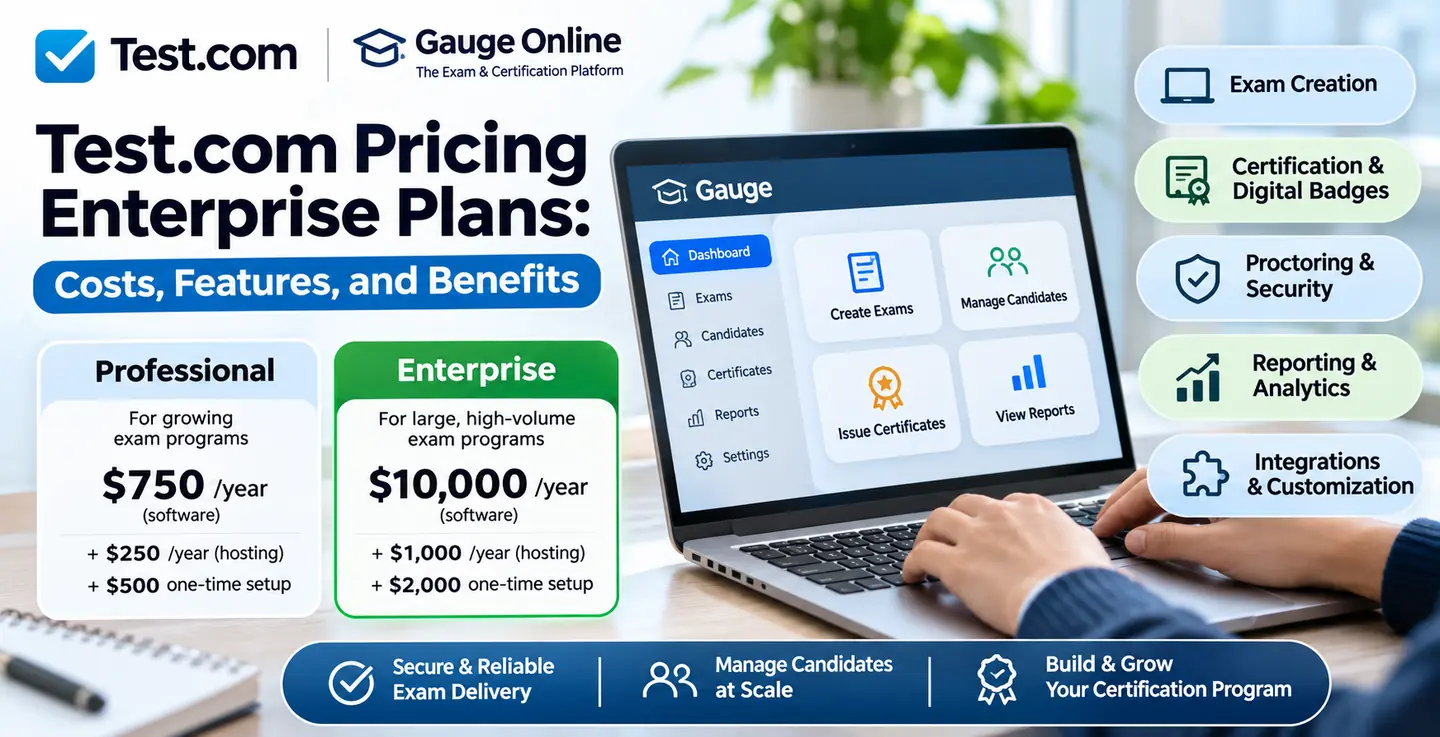
Professional starts at $750 per year for software, with $250 for hosting and a $500 one-time setup fee. Based on those figures, the starting first-year amount is $1,500 before any other applicable costs.
Enterprise starts at $10,000 per year for software, with $1,000 in annual hosting and a $2,000 one-time setup fee. Adding those published components gives a starting first-year amount of $13,000.
These are useful planning figures, not fixed quotes for every customer. Gauge prices programs by exam volume and required modules, so a written proposal is essential for a reliable budget.
How Much Does Enterprise Cost in the First Year?
The first-year calculation includes three separate charges. Keeping them separate helps finance teams understand which expenses are recurring and which should usually apply only when the service begins.
- Software: starting at $10,000 per year.
- Hosting: $1,000 per year.
- Setup: a one-time charge of $2,000.
Together, these listed amounts total $13,000 for the first year. In later years, the same starting software and hosting charges would total $11,000 annually if those prices stayed unchanged and no additional charges applied.
However, $13,000 should not be treated as a guaranteed minimum invoice or a complete package price. The public information does not fully explain how the annual starting charge combines with volume-based pricing in every contract. Ask for an itemized quote that explains the calculation.
How Does Exam Volume Affect Pricing?
Gauge positions Enterprise for organizations delivering more than 10,000 tests each year. This threshold is about the number of exam attempts, not necessarily the number of individual candidates. One person may take more than one test.
The company advertises Enterprise volume pricing starting at $3 per test, with lower rates for larger volumes. It also says its highest-volume customers can pay well under $1 per test. Those rates depend on the agreement and should not be assumed for a specific program.
For example, a provider expecting 15,000 exams should ask whether its price includes a committed number of attempts, how extra attempts are billed, and whether retakes count.
Also ask what happens if volume falls. Confirm whether pricing tiers can change and whether minimum commitments still apply during a quieter year.
Professional vs. Enterprise: Which Plan Fits?
Professional suits organizations starting a certification program or expanding an existing one. It includes advanced testing, user management, reporting, and security options. Gauge describes eight usage-based pricing levels for this plan.
Enterprise is aimed at higher-volume programs that need wider control over delivery and administration. Its advertised capabilities include certification and badging, lessons, eCommerce, proctoring integration, and developer tools.
A smaller training business may value the lower initial price and select only essential modules. A national credentialing body may need connected systems, complex permissions, and steady delivery across many test sessions.
Before choosing, compare the actual features included in each proposal. Some functions appear as separate modules in Gauge’s support materials, even when the Enterprise page presents them together. Confirm what the quoted package includes.
Exam Creation and Candidate Management Features
Gauge supports configurable exams, reusable question banks, and settings for how questions appear. Teams can build a straightforward knowledge test or a more structured assessment with sections and scoring rules.
Question banks help administrators reuse approved material without rebuilding each exam. Depending on settings, they can also vary question selection across attempts. This can support consistency while limiting repeated exposure to exactly the same questions.
Candidate management covers registration, user groups, access permissions, and progress records. Administrators can add people individually, import groups, or offer self-registration. Larger organizations may prefer automated enrollment through connected systems.
These controls are especially useful when departments have different responsibilities. Training managers can work with assigned groups, while senior administrators retain oversight of the wider program.
Certification, Digital Badges, and Learning Tools
A completed exam is often only one step in a certification process. Gauge can connect testing with certificates, digital badges, and learning activities so organizations can track progress toward a formal credential.
Certification features can support completion rules, expiration dates, and renewal reminders. This matters when qualifications must be updated regularly rather than awarded once and forgotten.
The lessons module adds guided learning content alongside exams. Organizations can arrange required activities in sequence and check whether candidates have completed each stage before moving ahead.
These tools may reduce manual tracking, but the exact combination should be confirmed in the Enterprise quote. A program that only needs final exams may not benefit from paying for a wider learning workflow.
Proctoring, Security, and Exam Integrity
High-stakes exams require steps to reduce cheating and protect candidate information. Gauge provides access controls, configurable authentication, and audit records. Organizations can also restrict access by user group or certain network conditions.
For supervised testing, Gauge supports on-site and virtual proctoring options. Remote services can use automated monitoring or human supervisors, depending on the provider and exam requirements. Session findings can be linked to candidate records.
Proctoring is an important budget item. Gauge states that virtual proctoring is priced per session, with rates affected by factors such as exam length and annual volume. Integration being available does not mean every supervised session is free.
Organizations handling regulated assessments should review security documentation and confirm the controls they need. They should also check privacy, record retention, and applicable laws in the countries where candidates take exams.
Reporting, Integrations, and Customization
Gauge offers reporting on scores, completion, candidate progress, and individual questions. Administrators can study results to identify areas where a course needs improvement or an exam item deserves review.
Reports can be exported in formats such as PDF, Excel, and CSV. That helps teams prepare internal summaries, share findings with reviewers, and retain records for an audit or quality check.
Enterprise features include a REST API, webhooks, and single sign-on options. These can help connect Gauge with an existing learning system, membership database, or customer management platform, reducing duplicate entry.
Customization extends to branding, user messages, and some interface settings. Buyers should confirm the work required for each integration, the support available, and whether technical development is part of the quoted service.
Main Benefits for Large Organizations
One practical benefit is centralization. When exams, candidate records, and certificates share a platform, staff may spend less time moving data between disconnected tools.
Another benefit is consistent delivery across teams and locations. User groups, shared rules, and reusable exam content can help a certification body apply the same standards to different audiences.
Reporting can also strengthen decisions. If many candidates struggle with the same item, administrators have information to review the question, the training material, or both. Better visibility is useful even when exam volume is stable.
The value still depends on implementation. A feature-rich system only saves time when staff use it well and the workflow fits their actual needs. Compare expected benefits with the full ownership cost, not just the annual subscription.
Additional Costs and Budget Questions
The published starting prices are only part of a realistic purchasing decision. Virtual proctoring, special integrations, training, and managed migration can affect total spending, depending on what is included in the contract.
Gauge’s support materials describe several modules that can be sold separately. Its Enterprise pricing page also describes volume packages with broad feature coverage. Because those descriptions serve different pricing situations, buyers should request a clear list of included and optional services.
Ask whether additional exam attempts, candidate retakes, payment processing, custom development, or special support create charges.
For US and UK organizations, confirm the billing currency, taxes, payment schedule, and any exchange-rate exposure. A written three-year cost forecast can reveal whether the service remains affordable as exam activity grows.
Free Trial, Setup, and Customer Support
Gauge advertises a 30-day free trial without requiring a credit card. A trial gives administrators an opportunity to explore the interface, build sample exams, and see how candidate registration and reporting work.
For larger programs, the company also offers a demonstration and a tailored pricing discussion. It says a trial environment can be prepared within two business days after the initial conversation.
Implementation may involve content review, exam imports, candidate records, configuration, integrations, and staff training. Organizations with years of certification history should ask what can be migrated and who is responsible for checking the records.
Gauge advertises support with its plans and annual billing without a required long-term commitment. Still, confirm response times, service expectations, renewal conditions, and the effect of cancellation before making a purchasing decision.
How to Choose the Right Test.com Plan
Start with an honest estimate of annual exam attempts. Include repeat tests, seasonal demand, future growth, and the number of different certifications your organization manages. A clear volume forecast makes pricing discussions more useful.
Next, identify the features your program cannot operate without. Secure exams, candidate reporting, certificate renewals, proctoring, and single sign-on may all matter, but not every organization needs every module.
Then test the workflow with actual administrators. Ask them to create an exam, assign candidates, review results, and produce a report.
Finally, compare written proposals using the same assumptions. Review first-year fees, recurring charges, volume changes, support, implementation, and contract terms. The best choice is the one that meets essential requirements at a manageable total cost.
Final Thoughts
Test.com Pricing Enterprise Plans are best understood through Gauge’s published starting charges and its volume-based approach. Enterprise software starts at $10,000 annually, with $1,000 in annual hosting and a $2,000 one-time setup fee. That produces a calculated $13,000 starting figure for year one.
Enterprise may suit certification bodies and training organizations that manage thousands of exams and need stronger administration, credentialing, and integrations.
The most useful next step is to request a detailed quote based on your real exam volume and required services. Confirm included modules, proctoring charges, and renewal terms so the final decision rests on a complete budget.
Frequently Asked Questions (FAQs)
What is Test.com Enterprise used for?
It is designed for organizations managing large online exam and certification programs through Gauge. It combines assessment delivery with candidate administration, reports, and options for credentials and integrations.
How much does Test.com Enterprise cost per year?
The advertised software price starts at $10,000 annually, plus $1,000 for hosting. A $2,000 one-time setup fee raises the calculated first-year starting amount to $13,000, before other applicable charges.
Is the $3 per-test rate the full Enterprise price?
Not necessarily. Gauge advertises volume pricing starting at $3 per test, but its public information does not fully explain how that interacts with every annual charge. Request a complete quote.
Does Test.com have a cheaper plan?
Yes. Professional software starts at $750 a year, plus $250 for hosting and $500 for one-time setup. The right package depends on exam volume and selected features.
Is proctoring included with Enterprise?
Proctoring integration is advertised, but virtual proctoring sessions are priced separately according to the provider and usage. Ask whether your quoted total covers the number and type of sessions you expect.
Can I try Gauge before purchasing?
Gauge advertises a 30-day free trial with no credit card required. Use it to test candidate registration, exam delivery, reporting, and the administrative work your team will perform regularly.