

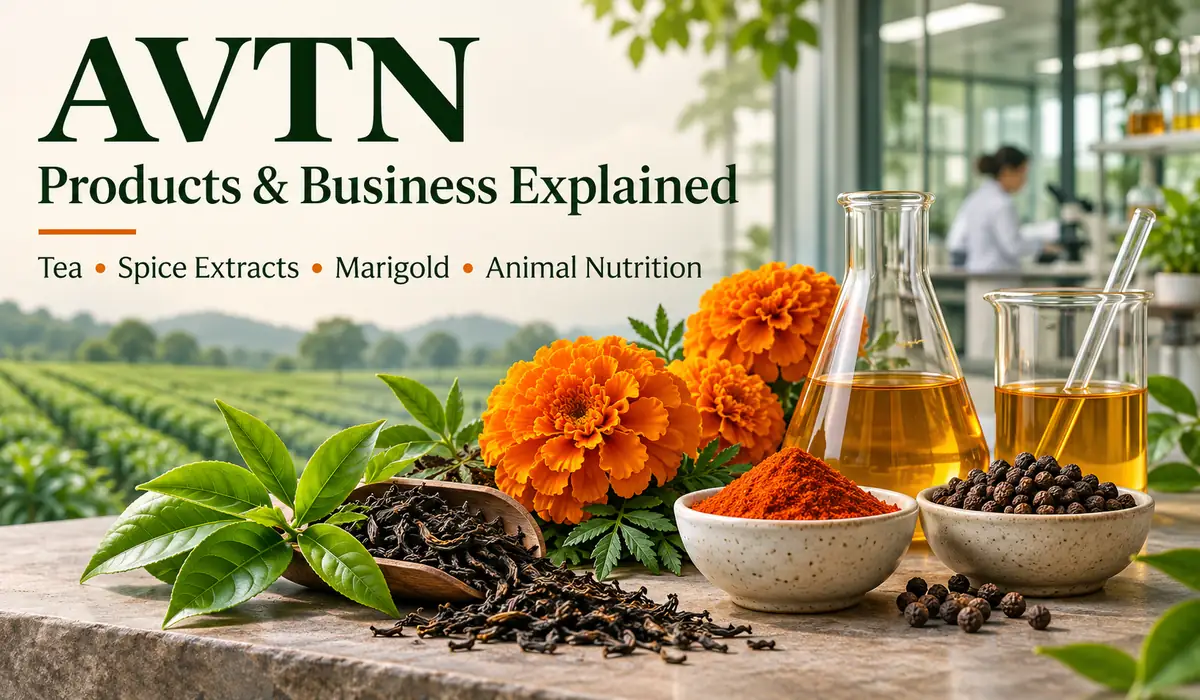
AVTN is a label used by some financial websites for AVT Natural Products Limited, an Indian company that makes plant extracts and natural ingredients. Its main business areas include marigold extracts, spice oleoresins, value-added teas, and animal nutrition products. It supplies ingredients that other businesses use in their own goods.
That makes the company different from a familiar supermarket brand. A shopper may never see its name on a package, even when buying a product made with ingredients from a specialist supplier like this one.
Understanding the business means looking beyond its stock listing. Its work connects farming, extraction, testing, and product development. Here is how those activities fit together and what its main products are designed to do.
What Does AVTN Mean?
In this article, AVTN refers to AVT Natural Products Limited. The label appears on certain market information platforms, but readers should check the full company name because short codes can have different meanings in different settings.
On India’s National Stock Exchange, the company uses the symbol AVTNPL. This distinction matters when comparing company profiles, share information, or announcements. A shortened label on a data website is not necessarily the exchange’s official trading symbol.
The business also uses the name AVT Natural in its branding. These names can appear together across company materials and financial pages. Confirming the legal entity first helps readers avoid mixing up unrelated businesses or similarly named products.
Company Background and Indian Roots
AVT Natural Products was incorporated in 1986 and has its registered office in Chennai, India. It forms part of the A.V. Thomas Group, which has interests across several industries, including plantations, spices, and natural ingredients.
Its position in the ingredient industry combines agricultural knowledge with industrial processing. Growing a useful plant is only the starting point. Manufacturers also need ingredients that meet agreed standards for strength, appearance, handling, and performance.
For example, two batches of crops may differ because of weather or harvest conditions. A commercial customer still needs a dependable ingredient for its recipe. Closing that gap between farm variation and factory requirements helps explain the company’s role.
The Main Products at a Glance
The easiest way to understand the portfolio is to group products by their main purpose. Some deliver color or flavor, while others serve beverage production, feed formulation, or agricultural applications.
- Marigold extracts for pigmentation and selected nutrition applications.
- Spice oleoresins and oils for flavor and color.
- Value-added teas, including instant and decaffeinated products.
- Animal health and nutrition ingredients.
- Agricultural crop inputs.
These categories serve different customers and should not be treated as interchangeable. A feed ingredient, beverage extract, and food color may require separate specifications, handling methods, and approval checks, even if all begin with plants.
The company also describes work in personal care and human nutrition. However, a broad market description does not establish how much revenue each activity generates. Understanding the product range and measuring its financial importance are separate tasks.
Marigold Extracts and Natural Pigments
Marigold extracts are an important part of the business. The company identifies applications in eye-care ingredients, food coloring, and poultry pigmentation. These uses involve processed extracts rather than ordinary flowers sold for home use.
In poultry production, pigment ingredients can help achieve desired egg yolk and skin colors. For a producer, the practical concern is consistent performance within a feeding program. Color targets can differ between customers and markets.
For buyers, the intended application determines what must be checked. An ingredient for animal feed should not be assumed suitable for a human supplement. Product grade, composition, documentation, and permitted use all need to match the finished product.
Spice Oleoresins, Oils, and Flavor Ingredients
Spice oleoresins are concentrated extracts that carry selected flavor, aroma, and color components from spices. AVT Natural’s published product range includes paprika, capsicum, and pepper oleoresins, among other offerings.
For a food manufacturer, the useful question is what the extract contributes to a recipe. One ingredient may mainly provide red color, while another adds heat or a pepper note. Those functions influence both selection and dosage.
Consider a seasoning producer developing a spicy snack. It may need a precise heat level without changing the recipe’s appearance too much. Comparing extracts by function is more useful than choosing solely by the name of the original spice.
Extracts also differ from ground spices in strength and handling. A factory cannot assume equal quantities will give equal results. Sample testing helps establish the right amount and shows how the ingredient behaves during processing and storage.
Value-Added Teas and Beverage Applications
Value-added tea is another major business area. The company offers tea products for ready-to-drink beverages and premixes, including green and black tea options. Its published portfolio also includes instant tea and decaffeinated tea products.
The term “value-added” describes processing or customization beyond selling a basic agricultural commodity. A beverage customer may need a particular flavor, color, brew strength, or ability to dissolve under specific preparation conditions.
For example, a powder intended for a cold drink needs to work in that setting. Testing only in hot water would leave an important question unanswered. Buyers should assess samples using the temperatures and mixing steps of their actual process.
The company also describes caffeine isolation and purification capabilities. However, purchasing a tea ingredient still requires a clear specification. Buyers should confirm caffeine requirements directly rather than infer a product’s composition from a broad category name.
Animal Nutrition and Feed Safety
AVTN’s animal nutrition activities include botanical feed additives, pigment products, and feed safety solutions. The company presents its range around areas such as gut health, nutrition, and protection of feed quality.
Its published offerings include Phytomax, OleoBOOST, and OleoXan. These names cover different product functions, so buyers need the relevant technical details. A product associated with gut health should not automatically be evaluated like a pigmentation ingredient.
Feed safety products address another set of needs. The company describes antioxidant solutions and products intended to manage mycotoxin-related challenges. These are distinct problems requiring different assessment methods and supporting information.
For example, preventing oxidation during storage is a different task from managing contamination in raw feed materials. Clear purchasing briefs help technical teams identify the right product category before comparing prices or arranging trials.
Farming and the Supply Chain
The company describes a vertically integrated model for selected ingredients. In practical terms, this means involvement in several stages of production, including plant selection, cultivation, extraction, and formulation. The extent of that involvement depends on the ingredient.
It also works with contract farmers. This relationship connects crop production with industrial requirements, giving the business a way to coordinate agricultural sourcing with the needs of its processing operations.
Even with close supply chain management, agriculture remains variable. Buyers planning a long production run should discuss seasonal availability and supply arrangements early. A useful sourcing plan considers both the current sample and the ability to deliver future batches.
Processing, Testing, and Product Formats
AVT Natural describes capabilities in extraction, purification, formulation, and laboratory analysis. The purpose is to turn variable plant material into ingredients with defined characteristics that customers can use in repeatable manufacturing processes.
Delivery format is part of that work. The company lists options such as granulated powders, water-soluble granules, beadlets, and infused oils. Availability depends on the ingredient and the intended application.
Think of a powdered drink and an oil-based mixture. Each presents a different handling problem, even when the desired function is similar. Choosing a suitable format can reduce difficulties with mixing, distribution, or storage.
A buyer’s review should therefore cover more than ingredient strength. Batch results, storage instructions, packaging, shelf life, and performance under actual production conditions all help establish whether a sample is suitable for commercial use.
Customers and International Business
The company mainly serves other businesses. Its ingredient markets include food and beverage manufacturers, animal nutrition businesses, and companies working in nutrition and personal care. The final product may carry the customer’s brand.
Its international network includes entities in the United Kingdom, North America, Mexico, and the United Arab Emirates. This gives the group a business presence beyond its Indian base, although an overseas office does not necessarily mean local manufacturing.
For a customer in the United States or United Kingdom, practical questions include who handles the order, where goods ship from, and which documents accompany delivery. Clarifying those details early can prevent confusion when production schedules become tight.
How the Business Makes Money and Faces Risk
The business earns revenue through the production, trading, and distribution of ingredients. Commercial value comes from supplying a usable product that meets a customer’s requirements, rather than simply reselling an unprocessed crop.
However, sales growth does not automatically mean every division performs equally well. In its 2025–26 review, the company described a recovery in marigold and strong tea beverage performance, alongside challenges in decaffeinated tea.
The same review illustrates why agricultural and international exposure matter. Weather can affect crop supply, while competition, customer demand, and trade conditions can affect selling opportunities. These pressures may influence different products at different times.
Anyone assessing the business should separate its product story from its financial results. A useful ingredient can still face pricing pressure. Comparing reporting periods also requires care, especially when figures cover different combinations of the parent company and subsidiaries.
What Buyers Should Check Before Ordering
Start with a precise description of the intended product. A supplier needs to know the application, production method, target market, and required function. “Natural extract” alone leaves too many important questions open.
Next, request the current specification and a suitable sample. Agree on the tests that matter before moving to a larger order. That makes discussions about performance more concrete and helps both sides understand what successful use looks like.
Finally, confirm commercial details such as minimum order quantities, lead times, packaging, and delivery responsibilities. Certification and suitability claims should relate to the specific ingredient and manufacturing site involved. A general company statement cannot answer every product-level question.
Final Thoughts
AVTN is best understood through AVT Natural Products’ role as a specialist ingredient supplier. Its core activities bring together plant sourcing, extraction, tea processing, and formulation for customers that manufacture food, beverages, feed, and other products.
Its main product categories explain what it sells. The more useful business insight is how those ingredients solve specific production needs, whether that involves flavor, color, beverage preparation, or feed formulation.
For readers researching the company, begin with its full legal name and the correct market symbol. For buyers, begin with the exact application. Both approaches make it easier to distinguish broad descriptions from the details that support a sound decision.
(FAQs)
What is AVTN best known for?
In this context, AVTN refers to AVT Natural Products Limited. The company is known for plant-based ingredients, especially marigold extracts, spice oleoresins, value-added teas, and animal nutrition products supplied to other businesses.
Are AVTN and AVTNPL the same company?
Some financial websites use AVTN when referring to AVT Natural Products. Its NSE symbol is AVTNPL. Check the full company name and exchange before comparing listings, since platform labels can differ.
Does AVT Natural sell finished consumer products?
Its core business is supplying ingredients and customized solutions to commercial customers. Readers should not assume every extract is packaged or suitable for direct household use; intended use depends on the specific product.
What are spice oleoresins used for?
Spice oleoresins provide concentrated spice characteristics, such as flavor, heat, or color. Manufacturers select them according to a recipe’s needs and test their strength and behavior before setting a commercial dosage.
Does the company make instant tea?
Yes. Its value-added tea range includes instant tea products alongside other tea ingredients. Customers should confirm details such as solubility, flavor, caffeine content, and preparation conditions for the particular product they need.
Where is AVT Natural Products based?
The company is based in India, with its registered office in Chennai. It also has an international business network, including entities serving markets in Europe, North America, Mexico, and the United Arab Emirates.




[…] Down,” a collaboration with German DJ and production duo VIZE. The track expanded Gregory’s reach into dance-pop territory and performed strongly across European markets. According to AllMusic, the collaboration reached […]
Comments are closed.