

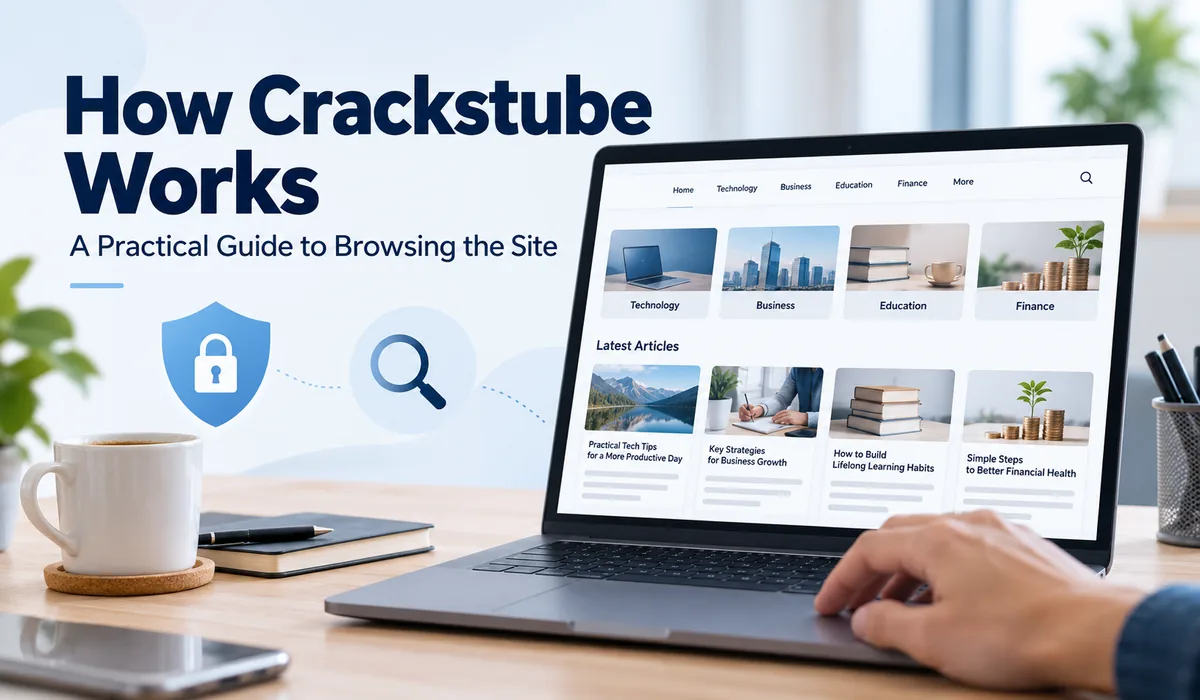
The name “Crackstube” can lead to confusion because search results use it for more than one website or online topic. One identifiable site, CracksTube.com, presents itself as a digital publishing platform with articles across several subjects and opportunities for guest contributions. Other sites and third-party pages use similar names, so readers should check the address carefully before assuming they have found the same service.
This guide explains how to approach the site as a reader: confirm the domain, browse its visible pages, assess its articles, and protect your privacy. Details can change, and public descriptions do not independently verify ownership, editorial standards, or every site feature. Treat the exact website in your browser as the source of current information.
Start by Checking the Exact Website Address
Before browsing, look at the full address in your browser. “Crackstube,” “CracksTube.com,” and other similarly named domains may belong to different operators. A shared name does not prove that the websites are connected or offer the same services.
Check the spelling, domain ending, and any extra words in the address. Be cautious of links that use unusual extensions, misspellings, or added terms that imitate a familiar site. If you reached the page through an advertisement or an unfamiliar message, verify the address before clicking further.
An address beginning with HTTPS means the connection is encrypted between your browser and the website. It does not confirm that the site is trustworthy, that its articles are accurate, or that its downloads are safe. Use it as one technical check, not as a complete safety judgment.
Understand What the Name May Refer To
Current public descriptions identify CracksTube.com as a multi-topic publishing site. Its presentation points to informational articles and guest-posting opportunities. This makes the site appear more like a general online publication than a dedicated software store or a single-topic video service.
However, search results also show other pages using “Crackstube” in different ways. Some third-party descriptions associate the name with streaming or software downloads, but these claims do not establish that they refer to CracksTube.com. The domain matters more than the general name.
When a website’s identity is unclear, do not rely on a summary page alone. Open the exact domain, inspect its homepage and policy pages, and compare what the site says about itself with what you actually see there.
Browse the Homepage First
The homepage is a useful starting point for understanding a publication. Look for its main menu, article categories, recent posts, and any explanation of the site’s purpose. These elements show how the website organizes its material and what subjects it currently covers.
A multi-topic publication may include sections such as technology, business, finance, education, or other general-interest areas. The categories can change, so use the live homepage to confirm what is available instead of assuming that an older description is still accurate.
Take a moment to notice whether the page is easy to read. Check if article titles describe the content clearly, whether dates and author names are visible, and whether the menu works on your device. Clear navigation helps readers decide where to go next without clicking unrelated promotions.
Use Categories to Find Relevant Articles
If the site has category links, choose the one closest to your interest. Categories can narrow a broad collection of posts into a more manageable list. A reader looking for business guidance, for example, can begin with the business section instead of scrolling through every recent article.
Category labels are helpful, but they do not guarantee that every post fits the section well. Read the title and opening paragraphs to check whether an article addresses your question. If a category page contains many unrelated posts, use the site’s search box if one is available.
Some websites display category links in a top navigation bar, while others place them in a sidebar or footer. On a phone, the menu may be collapsed behind an icon. Open it once and scan the options before selecting a page.
Open an Article and Check Its Structure
A typical publishing site presents articles as individual pages. Select a title from the homepage or category list to open the full post. Once there, review the headline, publication date, author information, headings, and any images or tables that help explain the topic.
A well-organized article usually states its subject early and uses headings that make it easy to scan. Look for explanations that answer the title’s question, give relevant examples, and distinguish established facts from opinion. A long article is not automatically a thorough or reliable one.
If the page includes related articles, use them as optional next steps rather than assuming they support the current post. Check whether each link leads to relevant material. Close or avoid unexpected tabs, download prompts, and pop-ups that do not serve your reading task.
Assess the Quality of What You Read
The site’s layout can help with navigation, but it cannot prove that every claim is correct. For factual topics, look for named authors, publication dates, clear explanations, and references to primary or authoritative evidence. If an article gives precise figures or makes a high-impact claim, verify it elsewhere before relying on it.
Pay attention to the language. Articles that promise guaranteed results, make sweeping claims without evidence, or use vague wording may need extra scrutiny. A responsible guide should explain important limits and avoid presenting guesses as confirmed facts.
For health, legal, financial, or safety decisions, do not use a general-interest article as your only source. Consult a qualified professional or an official source that is responsible for the relevant subject. Treat the website as a starting point for reading, not as a substitute for expert advice.
Decide Whether You Need an Account
Reading articles may not require registration, but features can vary by page and over time. Before creating an account, check whether the site actually requires one for the action you want to take. Do not provide personal details just because a banner or pop-up asks you to sign up.
If registration is offered, read the form and privacy information first. Check what information is requested, how the site says it will use that information, and whether marketing messages are optional. A request for payment information is not needed for ordinary reading unless you are clearly using a paid service.
Use a unique password for every account. If the site offers a newsletter, you can decide whether it is useful after reviewing its frequency and opt-out terms. Avoid entering sensitive details such as identity documents or banking information on a site unless there is a clear, legitimate reason.
Treat Guest-Posting Information Separately
CracksTube.com’s public descriptions mention guest-posting opportunities. That may interest writers, businesses, and publishers, but it is a separate activity from browsing articles. A reader does not need to submit content or contact the site to explore its public pages.
If you are considering a contribution, review the site’s own submission rules and contact details. Look for requirements about original writing, topic fit, editing, author credit, fees, and publication timelines. Ask for written terms before agreeing to pay for placement or provide work.
A guest-post offer is not proof of editorial review or audience reach. Evaluate the publication by reading its recent content and checking whether the intended readers match your goals. Avoid making claims about traffic, ranking, or business results unless the publisher provides evidence that you can independently assess.
Browse on a Phone or Computer
A publication website can usually be read in a desktop or mobile browser. On a larger screen, the full menu and sidebar may be visible. On a phone, the layout may stack content vertically, and some navigation links may appear under a menu button.
If the page loads slowly, try refreshing once or opening it in a current browser. You can also check your internet connection or disable a browser extension that is interfering with the page. Avoid installing a special app unless the site clearly provides an official app through a recognized app store.
For comfortable reading, adjust your browser’s text size or zoom. If a page is difficult to use with a keyboard or screen reader, try the browser’s built-in accessibility options. A site’s usability can differ across devices, so testing the same page on another browser may help identify a local display problem.
Recognize Common Access Problems
A page may fail to load because of a temporary outage, a mistyped address, a network issue, or a change to the website. Confirm the spelling first, then try reloading the page. If the homepage works but one article does not, the specific page may have moved or been removed.
A blank page or repeated redirect can also come from browser settings, cached data, or extensions. Try a private browsing window or another browser before changing security settings. Do not turn off antivirus protection or ignore a browser warning simply to reach a page.
If a site asks you to install a file to view an ordinary article, stop and reassess. Reading a text page should not normally require an unknown program. Close the prompt and return to the homepage by entering the address yourself.
Protect Your Privacy While Browsing
Read the privacy policy to see what information the site says it collects and how it handles that information. Policies can describe cookies, analytics, contact forms, and third-party services. If the policy is missing, vague, or hard to understand, limit the information you share.
Do not assume that a page is harmless because it looks like a standard blog. Avoid clicking suspicious ads, granting unnecessary browser permissions, or sharing your location when it is not needed. If a pop-up says your device is infected or urges immediate action, close the tab rather than following its instructions.
Keep your browser and operating system updated. Use built-in security tools and be cautious with files from unknown sources. For ordinary reading, you should not need to download software, browser extensions, or media players from an unfamiliar page.
Separate Articles from Downloads and Streaming Claims
Some online descriptions associate “Crackstube” with downloads or streaming. Search-result claims alone are not enough to confirm what a particular domain currently offers. Check the actual site and its policies rather than assuming that similarly named pages share content or ownership.
Do not download software or copyrighted media from an unverified page. Unauthorized copies may expose users to malware, unwanted programs, privacy risks, or copyright issues. The rules can vary by country, and the legality of a specific use depends on the content and circumstances.
If your goal is to watch films, sports, or other media, use licensed services available in your region. If you need software, download it from the developer or an authorized store. These routes make the source clearer and reduce the risk of tampered files.
Compare Information Before Acting
When an article gives advice, compare its main points with other credible sources. For technical topics, look for documentation from the product maker or a recognized standards body. For public services, check official government pages. For research claims, look for original studies or trusted scientific organizations.
This is especially useful when the topic affects money, health, privacy, or legal rights. A general article may simplify complex rules or omit local differences. Readers in the United States and the United Kingdom, for instance, may face different regulations, services, and consumer protections.
Keep track of the date of the information. Websites can retain older posts after products, rules, and services have changed. If a page does not show when it was published or updated, verify time-sensitive details before acting on them.
A Simple Way to Browse Crackstube
A careful browsing routine can help you get useful information without assuming too much about the site. Start with the exact domain, review the homepage, and choose an article that clearly matches your question. Check its author, date, structure, and supporting evidence as you read.
Use the following quick checks when a page asks you to take an action:
- Confirm the full web address and spelling.
- Read the site’s relevant policy or submission terms.
- Avoid unexpected downloads, permission requests, and payment prompts.
If the site’s identity remains unclear, leave it and look for a more authoritative source. A useful page should let you understand what it offers without pressuring you to share personal details or install unfamiliar files.
Final Thoughts
Crackstube is not a name that identifies one universally clear online service. The most identifiable CracksTube.com result presents itself as a multi-topic publication with guest contributions, while other similarly named pages may describe different services. That makes checking the exact domain the most important first step.
Browse the live site as you would any unfamiliar publication: inspect its navigation, read its policies, assess article quality, and keep personal information private. Do not rely on a similar name, a search snippet, or a third-party description as proof of what a specific website does.
(FAQs)
What is Crackstube?
“Crackstube” is used in connection with multiple websites and online descriptions. CracksTube.com currently presents itself as a multi-topic publishing site, but other similarly named domains may have different purposes.
How does CracksTube.com work?
It appears to work like an online publication: readers can browse its homepage, categories, and article pages. Its public descriptions also mention guest-posting opportunities, which should be checked on the exact site.
Is Crackstube the same as CracksTube.com?
Not necessarily. Similar names do not prove common ownership or identical content, so check the complete web address before relying on information about a site.
Do I need an account to read Crackstube articles?
That depends on the exact site and page. Check whether registration is genuinely required, and avoid providing personal information when you only want to read public articles.
Is Crackstube safe to browse?
Safety cannot be judged from the name alone. Verify the domain, avoid suspicious pop-ups and downloads, and do not share sensitive details unless you understand why they are needed.
What should I do if a Crackstube page will not load?
Check the address for spelling errors, refresh the page, and try another browser or network. Do not install unknown software or disable security protections to access an article.




[…] can be spread on toasted bread or crackers, stirred into a sauce, or used as a filling for pasta. It can also enrich risotto, pizza, or baked […]
Comments are closed.