

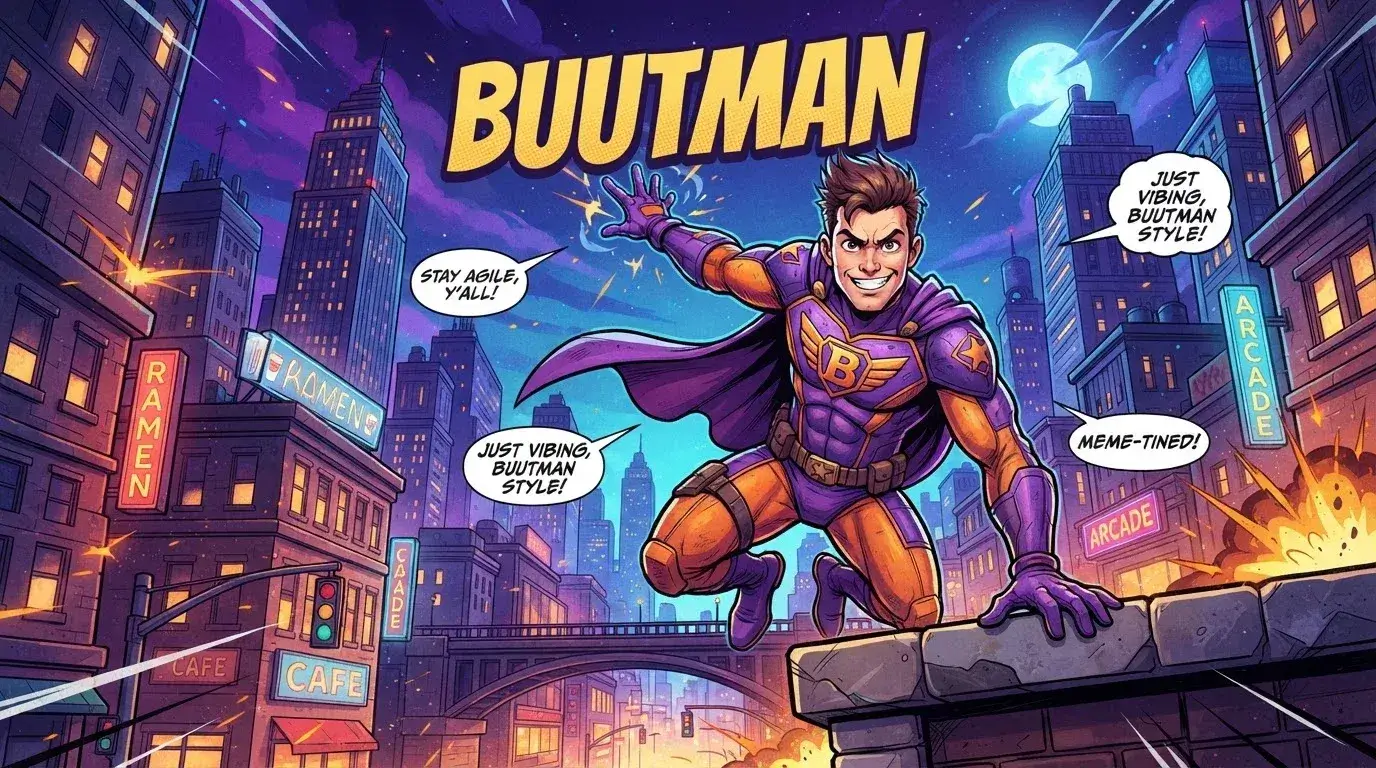
Buutman is the kind of unusual name that can make someone stop scrolling. It looks familiar, yet its meaning is far from obvious. The resemblance to Batman raises an immediate question: is Buutman a superhero spoof, an internet joke, or simply a creative username that happens to sound similar?
The distinction matters because a catchy name is not proof of an established character. Online descriptions connect Buutman with memes, digital art, gaming, and parody, but they do not establish one universally recognized identity or a documented origin story.
This guide examines what can reasonably be said about Buutman, why Batman provides a natural comparison, and how superhero parody works online. It also explains how to recognize genuine fan creations, assess uncertain claims, and understand the difference between inspiration and an official connection.
What Is Buutman?
Buutman is an uncommon term whose meaning depends on where it appears. It may be used as an online alias, a fictional name, or a label for humorous artwork. At present, there is no well-established, single definition that connects every appearance of the word to one creator, character, or project.
A username can be meaningful within a small gaming group, while a similar name on an illustration may refer to a completely different character. Online names often gain context from the image, caption, account history, and community surrounding them.
For someone searching for Buutman meaning, the most useful starting point is to identify the specific post or account involved. The name alone cannot reliably reveal whether the material is Batman-related, satirical, or unrelated to superheroes.
| Question | What is currently supported |
|---|---|
| Meaning | No single verified definition |
| Original creator | Not reliably identified |
| Official DC status | No verified official connection |
| Batman relationship | Possible wordplay, not a confirmed origin |
| Typical interpretations | Username, fictional label, or possible parody |
| Popularity | Broad viral reach has not been established |
Why Does Buutman Sound Like Batman?
The clearest connection is linguistic. Both names end with “man,” a familiar feature of superhero identities, and their short, punchy structure creates a similar rhythm.
Changing the beginning of a famous name is also a common joke-writing technique. A slight alteration can make a serious character sound awkward, exaggerated, or deliberately silly.
Batman is especially recognizable because audiences associate him with a dark costume, gadgets, secrecy, and a dramatic approach to fighting crime.
A playful near-name can prompt those associations before a viewer even sees an image. That is why someone might interpret Buutman as Batman-inspired on first reading.
However, resemblance is not evidence of intent. The spelling could have been chosen independently or created through a private joke. Without an original caption, a creator statement, or artwork that makes the comparison explicit, it is more accurate to describe the Batman link as an interpretation rather than a documented fact.
Is Buutman an Official Batman Character?
There is no reliable basis for presenting Buutman as an official Batman character or part of DC continuity. Batman himself is an established DC superhero whose first appearance was in Detective Comics #27 in 1939. His fictional world includes Bruce Wayne, Gotham City, well-known allies, and recurring villains.
An official character usually has an identifiable publishing history or appears in authorized comics, films, television, games, or promotional materials. Fan-made creations may borrow recognizable elements without becoming part of the original franchise.
It is also important not to confuse “unofficial” with “fake.” A fan character or parody can be a genuine creative work even when it has no studio approval. What remains uncertain is whether different online mentions of Buutman refer to the same work at all.
What Makes a Batman Parody?
A parody imitates recognizable features of an existing work to create humor, criticism, or a fresh perspective on its subject. For Batman, a creator might exaggerate his gloomy voice, make his elaborate equipment wildly impractical, or place a self-serious crime fighter in an ordinary situation.
Satire and parody overlap, but they are not identical. Parody generally comments on the work it imitates, while satire may use a superhero-like figure to criticize something broader, such as celebrity culture or online behavior. A costume resemblance by itself does not establish either purpose.
If Buutman appears in a drawing with a cape, an absurd utility belt, and exaggerated detective dialogue, readers might reasonably see a Batman parody. That is a hypothetical example of how the comparison could function, not a description of a verified Buutman storyline. The actual image and its creator’s framing would determine the interpretation.
Batman’s Long History of Comedy and Spoofs
Batman has provided material for comedy for decades because his serious personality is easy to contrast with ridiculous circumstances. The colorful 1960s television interpretation, starring Adam West, made room for campy dialogue and theatrical villains. Later portrayals leaned into darker themes, giving comedians another version to imitate.
The Lego Batman Movie (2017) uses the hero’s brooding self-image and strained relationships for licensed comedy. Holy Musical B@man! is a separate stage parody that turns superhero conventions into musical humor. These examples show different ways creators can make familiar Batman traits funny without telling a standard crime-fighting story.
Neither example establishes a connection to Buutman. They provide context for why a Batman-sounding name might feel immediately suited to a joke. Superhero parodies work best when the audience recognizes both the original convention and the unexpected twist.
Buutman, Memes, and Fan Art
Internet memes often begin with a recognizable image, phrase, or character design that people can modify. A slightly misspelled superhero name can serve as a caption, a punchline, or the title of an original sketch.
The humor may be deliberately rough rather than polished, because a clumsy presentation can be part of the joke. A familiar character placed in an unexpected situation can often communicate a joke with very little explanation.
Fan art works differently. An artist may create a one-time design inspired by a comic-book character, or develop an original hero with distinct clothing, personality, and backstory.
Some online articles associate Buutman with art-sharing websites and meme communities, but those descriptions do not establish a continuous, independently documented history. To understand a particular image, inspect the artist’s title, posting date, description, and other work. Those details are more revealing than a broad claim that a mysterious character has become famous.
Buutman as a Gaming Name or Digital Identity
Gaming culture gives unusual names another possible role. Players choose handles that are memorable, funny, or intentionally confusing. A superhero-style username may express admiration for comics, poke fun at an established character, or have no deeper connection beyond sounding entertaining during a match.
An avatar adds another layer. Someone using a dark-cloaked character model could appear Batman-inspired even if the username was chosen for unrelated reasons. Likewise, a channel posting comedy clips might use a recurring nickname without presenting it as a fictional hero with fixed powers or an official biography.
Check whether the name is attached to original videos, gameplay, character drawings, or an actual account biography. Shared spelling across different services does not prove common ownership or a coordinated online identity.
How Online Parody Names Spread
A joke usually becomes recognizable through repetition with variation. Someone posts an image, another user changes the caption, and a third person builds a new joke around the same idea.
The original context can disappear as the material moves between group chats, video comments, image boards, and short-form posts. This makes tracing the first appearance of an unusual term particularly difficult.
Search engines create a second effect. When websites repeatedly publish explanations of an unfamiliar term, the number of search results may grow even when there is little evidence of a large fan community. A name can look widespread because many pages discuss it, rather than because people regularly use it in original creative work.
Buutman is therefore best approached as a case where visibility and cultural significance must be considered separately. A genuine viral trend would be easier to support with dated original posts, recognizable variations, community participation, and consistent engagement. Articles making dramatic popularity claims without that evidence should be read cautiously.
How to Check Claims About Buutman
Start with the earliest identifiable example rather than the most confident explanation. An original creator’s post may show whether Buutman was a Batman joke, an unrelated username, or a one-off drawing. Search summaries can offer clues, but they frequently remove details needed to understand the work accurately.
Compare dates and account histories carefully. A later article that repeats another website’s description is not independent confirmation. Likewise, two profiles with similar names may have different owners. A useful investigation separates direct evidence from interpretation and avoids turning unanswered questions into invented facts.
Before accepting a claimed Buutman origin story, look for these details:
- An original, dated artwork, video, or post
- A clear explanation from its credited creator
- Context showing whether Batman is actually referenced
- Evidence that later versions are connected
- Reliable signs of audience activity beyond repeated articles
This allows readers to enjoy an unusual name while remaining realistic about what has been established.
Fan Parody, Copyright, and Credit
In the United States, a humorous reference to Batman is not automatically an infringement, but labeling something a parody does not automatically make it lawful either. Fair use depends on the specific circumstances, including the purpose of the work, the copyrighted material involved, the amount used, and its effect on the market.
Creators should distinguish an original superhero joke from an unauthorized claim of official affiliation. Using a recognizable name or costume to criticize a character raises different questions from selling near-identical branded merchandise. Trademark concerns may also arise when presentation creates confusion about sponsorship or origin.
For audiences, accurate credit matters just as much. If an artist produces a Buutman illustration, the work should be attributed to that artist instead of being presented as anonymous evidence of a movement. Giving credit preserves context and helps prevent imagined histories from replacing real creative contributions.
Final Thoughts
Buutman is intriguing because it suggests a familiar superhero name without offering a verified, straightforward identity. Its possible resemblance to Batman makes parody a reasonable subject to explore, but a similar sound alone does not prove a shared origin, official relationship, or established series.
The broader story is about how online humor works. People remix recognizable conventions, invent playful names, and give ordinary usernames unexpected meanings. Some jokes develop dedicated audiences; others remain isolated experiments that are still entertaining in their original setting.
The best way to understand Buutman is to consider the specific artwork, video, or profile where the name appears. That approach produces a clearer answer than treating every internet explanation as fact, and it leaves room for genuine creativity without inventing a history that cannot be confirmed.
(FAQs)
1. What does Buutman mean?
Buutman has no verified, universally accepted definition. Depending on context, it could function as a username, invented character name, or joke. To understand a particular use, examine the original post or profile rather than assuming every appearance refers to the same subject.
2. Is Buutman related to Batman?
The names sound similar, and that resemblance makes Batman parody a plausible interpretation. However, no reliable evidence establishes that Buutman originated as a Batman spoof. A direct connection would require an original work or creator statement that clearly demonstrates the link.
3. Is Buutman an official DC Comics superhero?
No verified DC publication or authorized character profile establishes Buutman as an official superhero. A fan drawing or parody may be creative and legitimate as fan expression, but it should not be mistaken for an entry in Batman’s official fictional universe.
4. Is Buutman a meme or a real person?
Neither description can be applied to every use of the name. An online handle may belong to a person, while a separate image could use the same spelling as a fictional joke. There is no confirmed single public identity behind all mentions.
5. Where can I find Buutman artwork or videos?
Search for the exact spelling on art-sharing sites, video platforms, and social networks, then inspect original uploads rather than relying only on summaries. Include phrases such as “Buutman art” or “Buutman parody” to narrow results, but verify that each result is actually relevant.
6. Can people create their own Batman-inspired parody?
Yes, people can create original humorous commentary inspired by superhero conventions, but publishing or selling it raises separate intellectual property questions. U.S. fair use is evaluated case by case, so an original design, clear attribution, and avoidance of misleading official branding are sensible precautions.